Saturday, May 31, 2008

Deep Sea Discovery


This is for a speedpaint-like thing going on on a forum I visit, so I thought I'd repost it here. It didn't take very long, only an hour or two, but it doesn't technically count as a speedpaint.

Monday, May 19, 2008

The boat is finished!

I decided as I suddenly find myself with lots of free time that I would resurrect my interest in papercraft! Having built Link and lots of Spiky Babies last year, I decided to ramp up the difficulty, and built the King of Red Lions from Wind Waker.


It took me just under two weeks to build, and I'm very happy with how it came out.


Wednesday, April 16, 2008

End of the Group Project

I think it's time to write about my experience with the group project. I was hesistant about accepting a leader position as I knew it would probably involve stress and consantly wondering why I had bitten off more than I could chew, but I decided to go for it anyway. I was quite interested in being a leader purely on the organisation side, and I do seem to find myself in positions of responsibility outside of uni reasonably often. In my house I seem to organise pretty much everything money related - I don't do this because I want to boss people about but simply because I feel like if I didn't do it, nobody would.

I'm going to attempt to go through things chronologically with the aid of my Pig folder, where I basically documented every Team Pig and every Leader meeting there was. It might be interesting to type the leader meeting one up to chronicle our gradual descent into madness.

I did worry quite a bit initially for several reasons.
One: nobody really knew what they were doing. As soon as one leader had an idea, the rest of us rushed to copy them because it seemed like something we should be doing. We all had a meeting as soon as the brief was given out, we all set our blogs up and we all toured the Queen's building looking for inspiration. It took a little while to properly settle into the project and have our own ways of doing things
Two: I don't know very much. I freely admit that I am not the strongest in pretty much any discipline out there, and being faced with such a strong team was daunting. Would anyone respect my suggestions when I don't know as much as they do? Fortunately it because quickly apparent that all the leads were more than happy to explain things, and even go back to square one if necessary. It was easy to ask people for advice or explanations.
Three: As I have mentioned previously, I worry about things anyway, it tends to give me motivation to work.

Luckily for us, pretty much the first idea we thought of we decided to stick with. Our first idea was people holed up in the Queen's building, using it as a fort. Some kind of terrible circumstance had occurred, forcing people out of situations they usually controlled, and being penned into small areas, allowing nature to take over the outside world. Flooding compounds the problems faced by people in the building.
We started by researching, and producing concept art. A lot of our immediate ideas can be found in the final level. The idea of people trying to keep the trees at bay is reflected in Tom's graffiti. Jesus's idea of having the player on the walkway so they could look up and down but access neither direction is the core feature of the final level. It seems like the start of the project was years ago, and it's a nice surprise to check back and know that so many ideas were realised. Sadly though, Tom's bat people were never fully explored, maybe the world is just not ready for them.
I think researching things was one of our strong points. We chose a very accessible theme - flooding, plant life and abandoned buildings. Scott and Alex provided photos of abandoned buildings, the canal is just around the corner for things relating to slow moving water and the Bradgate park trip gave people lots of plant information. My significant other being an engineer helped no end, allowing me to provide accurate information on what would actually happen to the building should it flood, and to design a drawbridge for the inhabitants that would theoretically work.

We sat down and planned out the entire level once we had a clear idea of what we wanted. It would have been great to have made the whole thing, because it would just have expanded what we have now, but sadly we didn't have the manpower. Kitto used the plan to create a fantastic art style guide for each area, which was then used to produce concept art. Each person was assigned an area or two to concept and we starting producing asset lists based on these. I think having only a small amount of concept art really helped us, because each area had one solid vision behind it. Having too much might have made things too complicated.

I think it was around this stage in the project that I started to worry about my abilities as a leader. In my mind I didn't seem to actually be doing anything. Other leaders were managing conflicts, giving other team members a kick up the arse and generally keeping a tight grip on things. I wasn't doing any of that, the project just seemed to flow, mostly driven by the team leads, with me picking up the pieces and generally being administrative. Eventually I realised that this was what I wanted to be happening. I wasn't having to manage conflicts because there weren't any. I wasn't kicking people up the arse because everybody was getting on with it. I was quite happy to join in discussions, have everyone come up with ideas and then me write it all down and do the boring things like produce charts. This was what I'd had in mind as being leader's duties anyway, the stuff that no one really wants to do but someone has to.

With all the initial planning done, we set people test assets to check modelling skills. Once they were Ok'd, the hard bit began - the production line. For the next few weeks I felt like I had assets coming out of my ears. Everything seemed to take me far longer than it should have done and things would seem to be almost finished for ages. I think I got a bit hung up on texturing things perfectly, but I gradually got over it and got faster at producing assets. My prime time for asset production seemed to be late on Sunday nights, when my self-inflicted deadline of 'The End of the Week' loomed. As things started to appear in the blockout though, the project became more inspiring.

As Easter approched and another asset list came out, I decided to set myself the lecture theatre. It was another of those 'this will probably cause me stress and frustration, but if it works it'll be worth it' moments. Because it was so intrinsically linked to the shape of the blockout, I had to consult with Jesus in the labs a lot more. It was nice to have such communication, I could see how the level was progressing and also check that my asset fitted correctly. If we did this all again I'd encourage far more team use of the lab, as it allows everyone to give help and suggestions far more quickly and easily.

During Easter there was some drama. Alex's walkway had not fitted the blockout, so Tom had, at the request of the team as a whole, produced another one. Alex took offence and a feud broke out, which was thankfully resolved by Jesus. I felt pretty guilty that as team leader I wasn't there to deal with the issue, although I think the fact that the only real problem we had happened at a time when we had the least communication between the entire team is a testament to how well we managed generally.

And so we're almost at the current point. After Easter was the most pleasant time for me, everything was essentially finished, it just needed to be collected and polished. I could texture my infernal lecture theatre with relatively little stress, and also produce any odd assets that might be needed.

So, have I been a good leader? I'm putting myself on not sure bordering on yes. To be honest I think the group would probably have worked fine without a leader at all. We made all the big decisions together and the process flowed very nicely with input from everyone. It has been nice to be able to say 'we are doing it this way' when it comes to some things and know I'll get my way, but I definitely feel like I would describe my role as more team secretary than team leader. I tell everyone what they're doing, when they're doing it and shuffle papers afterwards, but they make the decisions about the how, why and what next. I think I've been able to adapt well to what my team needed from me, and at the end of the day we've got something to show, so I guess I must have done something right.

As a final note, a bit thank you to everyone in Team Pig for all the hard work you've put in over the last few weeks. It's been fun.
Matt: Your assets are really nice, and you were fantastic and did everything asked of you. You just need to speak up a bit more!
Scott: You weren't around all the time, but I knew you were still getting on with stuff. Your early ideas were great, and your random singing is always entertaining!
Alex: We had problems with the walkway, but you got a new lease of determination from the competition, and managed to get it to completion.
Caz: You are an asset making machine! You've improved tons and I hope you feel a lot more confident with max after all this, even if it does still misbehave.
Tom: You made a great 3d lead, you were happy to explain things and you were a fair critic, pointing out both the good and the bad in everyone's stuff.
Kitto: Your happy enthusiasm made the tough times a lot easier, and you really know your stuff when it comes to art. You were a great 2D lead.
Jesus: You have worked incredibly hard for this team. I certainly appreciate it, and I'm sure the rest of the team does too. We couldn't have done it without you.

Boss Hogg out.

Monday, April 14, 2008

Digital Masterpiece

Woohoo! Finished. This was quite fun to do, apart from the wheat, which was a pain.

Wheatfield with Cypresses, by Van Gogh.
Original:


Mine:

Saturday, April 05, 2008

God this task is hard

I stated earlier that art is successful if it provokes a reaction in people. But what if you have a piece of tat that simply provokes a reaction of horror at its complete lack of skill, instead of evoking the emotion it was supposed to? Look at this... thing, dredged up from the wonderful place that is deviantart.


It's clearly trying to portray some kind of melancholy, but instead all you see is the flaws. The background perspective is strange to say the least. There seems to be some kind of vanishing point going on with the trees but the water just spreads up the page instead of vanishing anywhere. There is no interaction between the character and the water she is standing in - the character herself seems to have a spine like a poker and only possesses one finger. I could go on. But is my distaste the same as that against works of modern art?

I think the severe backlash against work such as Hirst and Emin's is because people are feeling the emotions they are meant to be feeling when they experience the work, and they don't like what they feel. A lot of modern art does not adhere to typical 'right and wrong' rules like perspective because they may be exploring a different area, so they cannot be assessed on the same criteria.

The criteria for good and bad art needs to depend on what the work was trying to achieve. If it achieves the mood and evokes the feeling it was meant to, then it is a success. You can then go on to examine other points such as following rules of perspective and colour theory. Judging art by set rules is impossible, both because art constantly challenges rules themselves and because criteria that apply to one piece will not apply to another. How can you mark a sculpture to the same set of rules as a 2D sketch? They require completely different levels of viewer interaction.

It is at this point where the 'it' factor comes in again, as mentioned previously. So I suppose a lot of things come into play when assessing whether something is good or bad.

Does it achieve the mood/ portray the thing it was meant to?

Does it adhere to rules of art?

Does it have the 'it' factor?

Do I like it?

All these things must contribute, but it is hard to say how much emphasis should be put on each point. "Do I like it?" is perhaps the least important point for neutrally judging a piece of art, but it is a diffcult question to avoid. The 'it' factor should perhaps not come into play, but inevitably does in giving a piece impact. The implementation of the rules of art and the achievement of the mood the piece was supposed to portray are probably the most important factors. They also intertwine with each other. A piece like the one above can have a mood it is trying to convey, but may be let down its adherance to artistic rules. On the other hand, a piece may be technically very good, but lack any particular mood direction.

Ultimately a piece needs to do what it's supposed to, which is where yet another problem comes in, because who gets to decide that?

Monday, March 31, 2008

Bradgate Park Painting

I just finished this, and I'm pretty darn happy with it!
It's interesting to compare this to the previous photoshop picture I put on here. I colour picked on this one, whereas I didn't on the previous one. Looking back, the burnt house picture seems pretty cartoonish with its colour usage.
Photoshop is still relatively new to me in terms of my whole artistic education, and I'm still finding it tricky to translate some of my skills into a new medium. I feel like you don't really get much feedback from digital painting, and strange as it sounds, it bugs me a little that it does whatever you tell it.

Wednesday, March 26, 2008

Good and Bad

OK, I'm going to start tackling this one. I didn't want to start this as I felt a lot of it had been said in the initial talk we were given about it. Unlike creativity, good and bad can't really be researched very easily, so this is going to have to mostly be my own thoughts. I'm ususally pretty wary of writing down purely my own thoughts with no backup when it comes to factual matters, a mindset impressed on me by taking history A level I fear.

The first thing I think I should tackle is what good and bad even mean. I looked both up and they each have about 30 different uses each, amusingly the first definition for bad was 'not good in any manner or degree'- very helpful. But it basically breaks down to good always meaning positive and bad always meaning negative.
These words express the way humans feel the need to simplify the world around them. Right and wrong. Heaven and Hell. But it is important to keep in mind that these are entirely false constructs. All ideas of good and bad are learnt. Growing up, we rely on others to teach us what is right and what is wrong, and we absorb this information instinctively because it makes evolutionary sense to learn from the mistakes of those who have gone before us.

When you think about it, we take a lot of what we are told for granted. We simply don't have the time to test everything we are told for ourselves, so we weigh it up with what we know from our own personal experiences, and make a judgement on how likely it is to be correct. As Newton put it "If I have seen further, it is by standing on the shoulders of giants." Do you know from your own personal experience that the Earth revolves around the Sun? I highly doubt it. But you have heard from enough reputable sources that it does, and so far no one has come to you with any evidence saying otherwise.

So, back to good and bad. We are learning all the time, and our collective idea of what is good and what is bad in terms of anything must be changing all the time as human knowledge and experimentation changes. The impressionists were widely slated when they first exhibited their work - a clear sign that the wider world thought of them as "bad". But in the present day their work is highly respected and seen as aesthetically pleasing, signs of it being thought of as "good". So good and bad are transient concepts, and we can only really assess anything as being good or bad in relation to today's current values of them.

Monday, March 24, 2008

Game Design and Social Networking

I thought I'd write up the lecture we had the Wednesday we broke up, seeing as I took plenty of notes, and as it was cool and interesting.
The lecture was given by Guy Parsons, who currently develops online communities and ARGs (Alternate Reality Games). More on those later.

At university, we have the time and freedom to create new things. We can take risks that we might not be able to take were we in employment, and we can create small games that might be a commercial flop, because it doesn't matter.
Guy gave a few examples of small games that push the boundaries like this. There are some links in his corresponding blog post.
A lot of them looked pretty cool. Toblo was designed by students and has a physics engine that allows players to use the environment as weapons. One multiplayer game let users create maps in MS paint and then import them into the game world. There was even a way to use Excel spreadsheets as a game engine.

Building up a community around your game was a factor that Guy mentioned several times. If you have a loyal following, albeit a small one, it bring a lot of benefits. You keep your game new and interesting, both from your fans bringing in new players and from user generated content. You have an eager audience for anything new you might produce, and you can also use the visitors to generate income, either through charging for the game itself or through advertising.

Games should draw inspiration from anything and everything. Start with something you perhaps wouldn't associate with games, like a fine artist. An Escher inspired game called Echochrome is currently in development for the PSP and PS3, with the environment changing shape as you rotate the camera, allowing you to continue across the terrain. It's crazy stuff.
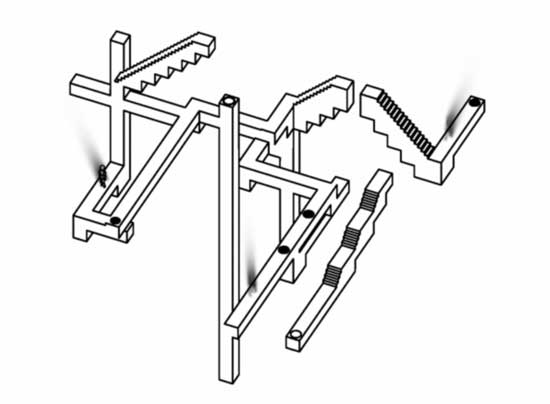
The bold and memorable art style of Team Fortress 2 is a good example of casting a wider net for inspiration. The Valve team were influenced by 1920s illustrations: here are some of their reference images with notations from their slide deck about the design process behind TF2. The slide show itself is a really interesting read, and goes into loads of mathematical shader detail. The 'fan reaction' section is quite fun, with loads of different game dev teams cosplaying as the TF2 classes.
These weren't actually in the lecture as Guy hadn't managed to find the images, but he later put them up on his blog:

An important thing to remember when coming up with a new idea for a game is that EVERYTHING is a game. This is nicely illustrated by Chore Wars, an online game where you compete against your housemates to see who can do the most chores and therefore earn the most points. If you can attach a score to it, anything becomes a game. Another example given was a website where you could download goals to aim for when running.
More examples of cool little games:
squidi.net - currently has 300 different types of game mechanics
Defcon - those who were at Gamecity will have probably seen this one. Basically it's the doom screen from every movie where there's a terrible war and the nukes are going off and everybody dies. You can't really win
Desktop tower defence - the popular Tower Defence custom game from Warcraft 3, but in flash game format set on a desktop
Kingdom of Loathing- An RPG that takes nothing about itself seriously. I saw some Kingdom of Loathing graffiti once in a toilet in Camden. A good example of the hardcore nature of KoL fans.
Bejewelled - A casual game where you have to line up 3 or more gemstones of the same type to get them to disappear. Casual games are tipped to be the next big thing, and this is a very popular one
Peggle - Another popular casual game
Scrabulous - Facebook application which is a Scrabble clone. Scrabble are sueing the creators for copyright infringement
Line Rider - The little dude will ski down the line you draw
Audiosurf - If you've been anywhere near Joel in the last couple of weeks you'll know about this game. It's like a cross between Guitar Hero and a racing game, and it can use any song in your library to generate a race track. It's available to buy on Steam.

A relatively new and immersive type of game is the ARG, or Alternate Reality Game. ARGs present a game scenario which ties in closely with real life. There may be blogs, social networking profiles for characters, coded websites, real world location drops, and even interactions with actors posing as characters within the game scenario. The players of the ARG must work together to solve what is going on in the scenario, so the sense of community is strong.
Guy described it as for people who like stalking other people on the internet, only not as sinister.

The conclusions from the lecture were these:
  • University is a time where you have 3 years with no commercial constraints, and is a perfect time for experimentalism, innovation and creativity. If you come up with an idea, prototype it.
  • Inspiration comes from everywhere - life is a game. Pay attention to everyday life and draw inspiration from it. Because you're pretending, that makes it fun.
Oh, and here's Guy's Blog.

Friday, March 14, 2008

Keyboards and RPGS


I have decided I want a Dvorak keyboard. Here is the wikipedia on it, for those who are not in the know. Basically, the current Qwerty keyboard is intentionally the worst possibly layout for a keyoboard you can have. It was introduced when typewriters jamming was a common problem. By spreading the most commonly typed letters around the keyboard, typing becomes slower and the keys are less likely to jam.
I am quite proud of the speed I can type at, it probably stems from the amount of time I used to spend in internet chat rooms in my mid teens. But if I could become even faster, and have a keyboard which confuses other people to boot? Well that sound awesome!

This does bring up a serious point to do with stuff being good and bad. Sometimes things are the accepted norm, but they're not actually good, they're just so ingrained that people think they're good. How many people think about their keyboards? It's just a tool you use to get words on a screen, most people would probably assume that the current design is the best one possible.

Another example relating back to games that I can think of off the top of my head is the traditional RPG setting. If it's an RPG, it has to be set in Europe, in the middle ages, with Orcs and Elves and Dwarves and magic. WHY? There are infinite places/ eras/ situations that an RPG could be set, but it always comes back to this. I suspect that Dungeons and Dragons is to blame for this, with many a game designer enjoying a game of D&D either in the past or currently. Does everyone simply want to try to create the situations they were imagining in their roleplay sessions in immersive 3D?
Perhaps this is it, but why not create a new universe where you can tell your own stories? Have fun designing your own races? Make people see ordinary everyday things in a new light? But I suppose that involves effort and risk...

So I suppose the small conclusion I can get from this is that when you're doing something, don't assume that the way it's done now is the right way to do it. It might be just the opposite.

Monday, February 18, 2008

Grading Art

Is there actually any point in grading art?

art [ahrt] –noun
1.the quality, production, expression, or realm, according to aesthetic principles, of what is beautiful, appealing, or of more than ordinary significance.

I have a feeling my art foundation is going to show through on this one and I may end up using stupid flowery terms, so be prepared.
Art is as hard to nail down as creativity, but I would say essentially that art is about provoking a reaction in people. A lot of people get angry that things like this:are considered art, but by getting angry at it they're proving the work a success, even if it wasn't in quite the way it wanted to be.

On my art foundation, art was primarily about raw power, and not really about technical skill at all. There is a technical right and a wrong to art, but I guess they thought if you were that bothered about it, you could go figure it out yourself.
I was frustrated at the time because I'm someone that does value technical skill, and had been training it up throughout GCSE and A level, I suppose because the system had told me to. Technical skill is very easily gradeable, which is probably why it's pushed so much. You can dock marks for perspective or lighting being wrong, or give marks for good use of media.

Art Foundation was a shock because suddenly the goalposts had been moved. Who cares that you can paint a lemon in perfect photorealistic detail? Someone has vacuum formed a mould of it, shoved the lemon in a blender with half a newspaper and some dirt, shoved it all back into a lemon shape and explored something completely different to what you have. And at the end of the day, it's just as right as what you've done.

My Art Foundation seemed to be graded simply by whether you had the 'it' factor or not. Some people produced bugger all but got fantastic grades, and some people slaved away and had little to show for it. The frustrating thing was, you could see when people did have the 'it' factor, and when pieces of art had it too. The hard bit was getting it yourself, and I still have no idea how people managed it. Picking something to explore and chipping away at it constantly until it produced something interesting seemed to be one way of doing it, but some people seemed able to just pull it out of a hat.

Yes, my Art Foundation was frustrating, but it also taught me a lot about life and the art world. Nobody cares how long you spent on something or how you got there, it's simply about whether it's good and whether it has impact.

So that being said, why would anyone care what mark you got for your art degree? If you're going into the commercial art world, people are going to look at your portfolio and judge for themselves whether or not you have the 'it' factor they are looking for. If they decide not to hire you, you whingeing that you got a first won't change their minds.
Conversely, if you have completed your art degree but aren't going into the art world, no one is going to care about your portfolio, they'll only care about your grade. Your abstract representation of the war in Iraq using toothpaste and a piece of old tyre will probably not aid you in your interview for the position of regional manager at Generic Offices.

So in an ideal world, people would just be given whatever degree mark they felt like having at the end of it. Everyone could be given a first, and the commercial arts could simply not even look at the piece of paper with a grade on it, and go purely on portfolio like they do anyway.
And if people didn't feel like going into the games industry, or the art world in general, they could sashay off into a nice job with their shiny first. Everybody wins.

Yes I can see the millions of flaws in this plan, but if we just did it and didn't tell anyone, i'm sure it'd be fine.

Monday, January 21, 2008

Poor Blog

Poor blog, I feel I have been neglecting you in the excitement of the group project beginning.

Luckily I have something I want to talk about.
As I'm sure everybody knows, being an artist is hard sometimes. We've all had the 'Emo days' where you can't bear to look at your own work because you're convinced everyone in the world is better than you. It doesn't help when you're living with people who are on the same course as you either, as you have a direct comparison.
But you also have the days where you are so full of yourself you almost can't believe it. You've just finished something, it's awesome, everybody loves it, you're an art GOD.
But most of the time you have to live somewhere in the middle, caught between putting yourself down and bigging yourself up. You have to have some sort of ego going on, otherwise you'd never produce anything, but you also have to be self critical so you don't get complacent.

I can't seem to find a middle ground very easily. It's so easy to yo-yo between the two extremes and I doubt it's particularly healthy. My up days are pretty rare anyway. Pretty much as soon as I finish a project I worry I won't be able to do anything that interesting ever again. I have no idea where my creativity comes from and my method seems to simply be to work like blazes, which surely anyone could do?

But I seem to need to stress to drive myself onwards, and I am constantly striving to do better. We'll see how this translates into the group project work.

Saturday, January 12, 2008

Some attempt at wrapping things up

So what have I learned about creativity? While perhaps not directly related to the blog tasks, I've learned that creativity requires hard work. Both Jolyon Webb and Ben Mathis demonstrated their knowledge of pretty much everything, with special focus on anatomy and traditional drawing techniques. While being good at the area you're being creative in isn't strictly a requirement, having a broad base knowledge can make combinational creativity easier, and is essential for explorational creativity.

At least at the end of all this, I have found a definition of creativity that I agree with.
'Creativity is the ability to come up with ideas that are new, surprising and valuable'
Although most of these words need to be further defined, it at least does make immediate sense. It can also be further broken down into types of creativity: combinational, explorational and transformational as explained in my post about the lectures.

I've had a scan back and it seems that a lot of my blog posts end up looking at the idea of process behind creativity. Whether a process is creative or not, (eg cooking) what steps you can add to a process to enhance creativity (like limitations) or even where creativity occurs in a process as mentioned in the lectures.

I do feel like I understand my own creativity a little better. Everything is a process, beginning with a brief with contrainsts.
I don't think creativity is easy, it's something you have to work at. When I do a project for drawing, I don't go with my first idea. For the one day projects and the speed paints I've had to, and I think some of them have been pretty good, but I think they lack the depth of my formal projects. With both the mechanical and the organic projects I had an idea about mid way through which I could have gone with as my final concept. But in both cases either I decided it wasn't good enough, or was frankly told by Chris that it wasn't good enough, so I returned to the drawing board.

I often think about the process of coming up with a character or making your way towards a final outcome. So many ideas are rejected along the way, and a lot of them aren't actually bad, it's just that I decide to go with a different one. How many outcomes would I end up with if I actually went back over a project and followed every variation through?

I think my creativity works because I constantly churn out work. Even if most of it is useless, by the law of averages I'm still likely to find something worth using. Looking back on things, all I seem to do is go one way, find something I like, then go another way, find something else I like, and simply splice the two things together. Unfortunately this process can be a little frustrating while in the midst of it, because it feels like I'm wandering aimlessly until I find the elements I want to staple together.

Thursday, December 27, 2007

For once in my life I have actually produced something purely in photoshop that I'm happy with. I think having a tablet has made a lot of difference.
And as an added bonus, here's an animated gif of me painting it, although you'll have to click on it to get it display.

Sunday, December 23, 2007

Pop Art Portraits

I'd known about the Pop Art Portraits exhibition since the end of Summer, and was gutted that I'd have to go away to university again just before it opened. As such, I made getting into town and seeing it one of my priorities of the Christmas holidays.
Pop Art has always interested me. It combines bold and exploratory styles with a probing insight into popular culture.
The exhibition was very good, although I felt some of the subject divisions were a lot stronger than others. The Marilyn section was very thought provoking, with many pieces exploring the price of fame, and the person behind the image. By contrast, the Experience and Innocence sections seemed slightly contrived. How can you define a point in history at which the public suddenly loses hope and becomes jaded, never mind having artists reflecting that? Why is Elvis being portrayed with a gun instead of a guitar an example of Innocence rather than Experience? Surely the manipulation of image and celebrities' experiences with this would suggest the latter.

The opportunity to see some celebrated pop art images such as the Warhol Marilyn prints and "What is it that makes today's homes so different, so appealing?" by Richard Hamilton is always a welcome one. When you see artists' work in the flesh it is always such a different experience to seeing them in art books. Something is always inevitably lost in the translation from real world to print, even if the piece was print to begin with. Standing in front of Lichtenstein's "In the Car" is an experience beyond the image itself. You are slightly dwarfed by the scale of the piece. The car's inhabitants tower impassively over you. And yet, you feel like you are getting let in on a secret. Up close, the brush strokes can be seen, the bleeding of the Ben Day dots, an area where the edge did not mask properly.I should really get myself to some more exhibitions, I forget how much I enjoy them.

Monday, December 10, 2007

Creativity Conference

On Thursday morning I went to the Creativity and Innovation conference at the City Rooms. It was pretty interesting, and I definitely learnt some useful stuff, both about defining creativity and about where it occurs in our work.
The first speaker was Margaret Boden, attempting to answer the question 'What is creativity?'. She gave the definition of creativity as "Ideas that are new, surprising and valuable."
Many of the words in that sentence need to be further defined, however. New can mean either new in terms of all human history (H-creative), or simply new to the person themselves (P-creative). Although H-creativity may seem far more important, it must still begin with P-creativity. When teaching children, they may be encouraged to come up with their own ideas about how something works. The answer may be already known, but they are still being encouraged to be P-creative.
Value of a creative idea can change depending on the situation. An idea which may be great for an advertising campaign will probably not be as valuable for an art exhibition. When people are discussing whether or not something is creative, they are often not debating the core creativity at all, but differing about the creative value.
Surprise at a creative idea can occur in different ways, depending on what type of creativity produced the idea.

Combinational creativity:
is making unfamiliar combinations of familiar ideas

Exploratory creativity:
is working within a structure or style, and working to find the limits of a creative space

Transformational creativity:
is a new structure or style. The creator has learnt how to explore the space, and then changed the space itself.

Transformational creativity is rare and often only occurs after the creator has first mastered the existing creative space through many years of exploratory creativity. The backlash against transformational creativity can often be great, as they are challenging the current accepted system. An example of transformational creativity is the development of pointillism.

These definitions are theoretical distinctions between types of creativity. Creativity does not need to occur in one or other category, it can be a mixture.

Creativity can be discouraged by punishing new ideas, especially for being 'wrong'. Combinational creativity can be encouraged by having lots of ideas from different subjects readily available. Doing exercises such as making up a sentence or story to do with two random things can also encourage combinational creativity by getting the creator to think about the process itself. For successful exploratory creativity, the person needs prolonged experience in the area they are exploring. For successful transformational creativity, the creator should first examine other examples of transformational creativity and evaluate what they changed and how. They also need to learn to evaluate their own ideas. For all styles of creativity, the person's motivation needs to be encouraged.

The second lecture, by Claudia Eckert, was about analysing where creativity occurs in the processes of both artistic design and technical design.
Artistic design is design fields where visual or tactile appearance is key to the design and sale of the product, whereas in technical design the function of the product is more important.
I might skip to the conclusion for this one, as the main portion of the lecture compared different design processes in some detail. The main conclusion of the lecture was that creativity in technical industries such as engineering is seen as a necessary evil. It leads to uncertainties in the design process, which can mean increased production time and costs. Things are done sticking as strictly to the design process and brief as possible, and creativity occurs when a problem arises.
However, in artistic design, the process is almost approached from the other way. Creativity is factored in from the beginning, and through the design process itself the technical restraints are realised and decided upon.

It's interesting to think about where we fall in the processes. We're probably somewhere in the middle, we have a large amount of artistic freedom but we also have to stick to strict criteria.

Friday, December 07, 2007

Gender and creativity

I thought it would be an interesting idea to examine whether there are any links between creativity and gender. I did find a few papers online, most of which seemed to reach the conclusion that there isn't really any difference in creative ability based on gender alone. However, one paper did make an interesting point.
Girls in their early teens are more easily discouraged from being creative by a reward or assessment based system than boys of the same age group.

This is worrying. As creativity is inherent in pretty much every subject to varying degrees, does this mean that the discouragement of creativity is making girls less ambitious? If you are afraid to experiment, you will probably stick with what is safe and known to you. This article states that although girls are doing better and better at GCSE level compared to boys, they are still taking stereotypical subject choices.
This is a tough thing to think about. When you make decisions about what you want out of life, how often do you think of yourself as an ambassador for your gender? When I consider what I want to do, should I be considering working in the city as a high flying banker just because it's a male dominated arena?

This wasn't really as focused an exploration as I was hoping it would be, but it is at least an interesting aside.

Wednesday, November 28, 2007

It's review O' clock!

Since I've bought my Wii, I've felt like I haven't really been getting the most use out of the thing. I've got Wario Ware and Twilight Princess but for some reason I never really play them. Wario Ware is for a more party situation and Twilight Princess has annoyed me within the first few minutes, both with the art style and the gameplay (although I've since got over that). The Miis are hilarious but all the fun seemed to get milked out of that in the first few weeks. It seemed like my Wii was destined to be nothing more than a shiny Gamecube which we all only used to play Super Smash Bros Melee until Brawl comes out.

But then I bought Mario Galaxy, and realised that there was a sound reasoning behind me buying this console. Mario Galaxy is a wonderful game. It's not graphically impressive, it's nothing groundbreaking in the engine, but it is pure fun.
The hub world is a really nice environment that improves as you progress through the game. More and more areas light up and the whole place fills with Lumas, little star things that dance around looking cute. Other characters like toads and Luigi wander around, and the whole place feels very vibrant. The orchestra playing the background music also grows, making the music much more epic. From the hub world you can access the galaxies, or levels. The galaxies vary greatly, but most consist of separate planets with their own gravity fields.
The way gravity is used in this game is really inspiring. Like Braid uses time, Mario Galaxy uses gravity. Gravity can change in different areas, leading to platforming puzzles. The gravity gives a great twist to the gameplay. You get on a platform, it starts to move and dangerous objects are hurled at you for you to dodge. So far, so standard. But it's when you remember, hang on, i can stand on the underneath of this that it starts to get interesting.
The controls are pretty good too, given the constant changes in camera angles and directions Mario is actually facing. You simply press the way you want to be going, and ignore wherever might have been forwards beforehand.

Mario Galaxy is frankly inspiring in its gameplay and I'm hoping for more fun innovations from Nintendo in the future.

Tuesday, November 20, 2007

Limitations on creativity

It's strange to think that sometimes having limitations can open up more ways to be creative. I started thinking about this after Gamecity. Having helped out in the Indiecade for a couple of days, I was struck by what some of the games managed to achieve by actually have less going on that most mainstream games. The Indiecade, for those of you who may have missed out, was an arcade showcasing games made by tiny development teams or students. Some had been created entirely by a single person.

The fact that many of these games could not compete with the technological achievements of mainstream games actually seemed to free up the creative aspect of many of them. One of my favourites which I've actually downloaded and have been playing at home is Endless Forest.


In Endless Forest you play as a deer with a human face. You can communicate with other players simply through gestures and occasional mooing. There isn't really much of an aim either. You can explore, there are random events triggered by the game's creators, and you can collect different items to change the appearance of other deer from around the environment. It's easy to see why this could quickly become boring, but I find it quite liberating.
There's no pressure to do anything, and the fact that no one can type means you don't think of the other players as people sitting at their keyboards, but rather just as the deer they are presented as. It's very absorbing, and the fact that there aren't really goals makes it easy to dip in and out of.


Another game that was interesting was Braid. Braid is a 2D sidescrolling platformer. The main idea of the game is that we should learn from our mistakes, but not have to suffer the consequences of them. So in the game, you can rewind time at any point, for as long as you like. This way, if you are killed by an enemy, you can rewind time and revive yourself. You have now learned something about how or why the enemy attacked you, and can change tactics accordingly. The real puzzles begin when some items are not affected by time, or behave differently when exposed to time reversal. It leads to puzzles where you are forced to fling yourself onto spikes or drop to a place you have no way of escaping from in order to grab items such as keys which you can drag backwards through time with you.

While games such as Prince of Persia have the time rewind element, the fact that Braid has no limits on its rewind system makes you play completely differently. Prince of Persia still forces you to be cautious, whereas in Braid you can fling yourself into a situation just to see what will happen, and then reverse it if it wasn't the outcome you wanted.

So that's how it applies to games, but what about art? Forcing yourself into a limited artistic situation can lead to interesting results. It seems though, that you need to push it away from the familiar to really get deeper. Everyone uses pen and pencil, limiting yourself to just one of those doesn't cause any difficulties or present you with problems you have to solve.
However, if you only allow yourself to use tin foil and glue, or paint and a piece of card with no paintbrush to draw with, you start to open up more interesting things in what you are producing. The fact that you have having to fight your choice of media in order to show what you want makes you think differently than if you had chosen something you can use with ease, and this shows in the piece.

You get unexpected outcomes, things you didn't mean to put there simply because you're not good at using the media. Rips in the paper with the craft knife that actually look really good, mistake lumps of paint that show contours. Sure, it might look terrible, but that's the risk you take. And the best part is that you can give people the same media to use and everyone will use them differently, there is still personal style even in such an unfamiliar thing.

So what's my conclusion? A selling point for most games is going to be having the latest graphics and engine technologies. But sometimes the games without those things have got something more interesting to say than those with them.
If we can just learn to take risks with the small creative things we do, maybe it will feed into everything else.

Friday, November 09, 2007

Cooking

I thought I'd make a post about cooking. Cooking is one of my hobbies which has only really started once I got to uni. I think of cooking as being a very creative process, although it isn't normally mentioned in the list of creative things everyone has been making in these blog posts.
Having had a trawl around the internet, there's not that much about cooking in terms of the creative benefits it brings. It seems to be assumed that you're cooking to produce the end result, rather than enjoying the process itself.
I don't like this idea. Cooking can be as much fun as any other creative activity. My favourite thing about cooking is mixing stuff together. It's like making mud pies in the garden when I was a kid... only hopefully without the horrendous food poisoning which would inevitably result from actually eating mud pies.
Throwing in loads of things which on their own are rather unremarkable and turning them into something that tastes good is one of the most satisfying things for me. It reminds me a lot of painting - paints on their own are nice, but you have to put them together to really achieve something worthwhile. My rapidly expanding collection of herbs and spices reminds me of my mostly useless collection of art junk in my room. Sure, I don't have a use for tons of different types of wool right now, but one day I'm sure I will.

I think perhaps cooking isn't seen as being creative because you're following a recipe. When you have strict instructions, is there room to be creative? Of course there is. You have to exercise personal judgement in when stuff is done, when to move to the next step. You can do things differently to how the recipe says. You can add, substitute, take away, present differently. Or of course, you can always do things wrong. Sometimes you'll have a happy accident, other times you will do something monumentally dumb like burning rice and stinking out the entire downstairs of our house.

Of course, there is the theory that cooking is actually some elaborate form of procrastination, and that the whole process, creative or not, is simply an excuse for me to avoid doing my actual work. I'll let you be the judge.

Tuesday, November 06, 2007

Creativity continued

For my mechanical project I've been researching Leonardo Da Vinci, and one of the most interesting things I've found about him is how he managed to combine so many different skills and areas of interest.
Da Vinci was "an artist, architect, musician, scientist, geologist, physicist, designer, mechanic and inventor" as it says in the book I borrowed from the library. In the 1400s, artists weren't mainly hired for their artistic skills alone, but for their knowledge of engineering, which they acquired during their apprenticeship. In an age of changing warfare, new inventions and reworked traditional weapons were the key to success.
Learning about everything makes complete sense. It's what I thought my art foundation would be, being taught as many different ways of creating as possible, so you have more tools at your disposal. Unfortunately it didn't really work like that, which I think is a shame. For all I know, I could have some secret metalsmithing talent which will now forever lie dormant.

Things are split up far too much, especially when it comes to school subjects. History links to geography, which links to the sciences, and then maths, and then music and so on. Separating things so much makes sense from a teaching perspective, but also forces people to drive a wedge between their interests.

Is it wise to specialise? Does focusing on one subject specifically give you a deeper understanding, or should you widen your horizons and have a larger understanding of everything?

I've often wondered if it's best to train for something completely different to what you actually want for a career in life. That way when you do work your way there, you'll have a completely different outlook and set of skills to everybody else, and will maybe think in a more creative way about the tasks in hand. Having come from a wider employment circle, you'd also have more objectivity.

Perhaps we should all have an Ancient Greek style education, where we are apprenticed into as many different jobs as possible.