I've recently got back into papercrafting, I find it nice to have something physical to get my hands on, rather than just digital modelling and texturing. I've just finished making Clank and posed the question of who I should make next, Wall-E or Falco. Tom replied that I should make Falco, and then follow on to make the entire cast of Smash Brothers Brawl! A daunting task indeed, and I don't think there's any way I could do it without help, but just for curiosity's sake, I'm going to find out how many Brawl papercrafts are actually out there.
Successes
This page has:
Samus/ Zero Suit Samus
Lucas
Kirby
Mr Game and Watch
Falco
Ness
Ike
Ice Climbers
This page has:
Mario
Peach
Wario
Luigi
Bowser
Yoshi
Here's a nice, official looking
Pikachu
Snake in a box (one of the simplest papercrafts there is, a nice beginner's one)
Part 1
Part 2
Link
Toon Link
Meta Knight (this one isn't great. There's an amazing one out there somewhere but everything I find on it leads me to Japanese sites)
Jigglypuff
Donkey Kong
Lucario and instructions
Sonic
Half successes
Pokemon trainer (Squirtle, Ivysaur, Charizard) Here's a Bulbasaur that could possibly be photoshopped to become an Ivysaur
I couldn't find an Olimar, but I did find Pikmin
No King Dedede but there are Waddle Dee and Waddle Doo
No Shows
Zelda/ Sheik
Ganondorf
Fox
Wolf
Pit (although there is one in the process of being designed)
Captain Falcon
Marth
Diddy Kong
R.O.B.
If anybody finds one of the ones I couldn't, let me know. There's a lot of internet out there to look through, I'm sure I missed something.
Sunday, August 31, 2008

Thursday, August 21, 2008
Summary of the Beeb: Part 2
In the second week we began work in earnest. We were given a script to Dinosapien – a CBBC show about some kids camping in Canada
I probably spent about two days just acquainting myself with Second Life and earningLinden
I probably spent about two days just acquainting myself with Second Life and earning
Surprisingly, I probably got the most done out of the three of us. I didn’t get round to dialogue, but that could have been done reasonably quickly as I had a script to hand. The framerates and resolution of the video are absolutely appalling. My laptop was definitely not up to scratch, but Second Life looks quite dodgy anyway. I got really tired of staring at all the terrible models in Second Life, if you want to make anything, you have to make it out of primitives distorted and sort of mashed together, it's horrific!
Alex had an even harder time of it than me, seeing as he had to use Moviestorm. Moviestorm cannot do dinosaurs, cannot do people holding things apart from a few specific props, and can’t really do outdoor locations very well.
Dean had the best result, using Source. His was far more cinematic and just looked a lot nicer. He did, however, struggle with the AI. At the end of the video you can just see the AI override failing on the dinosaur and it rushing in to kill Alyx.
At the end of the week we decided to drop Second Life as it really has no redeeming features whatsoever, but to try out a sitcom format for Source and Moviestorm. Source had done well at this test, but drama or sitcom style shows would give Moviestorm an opportunity to prove itself.
Mod Stuff
I've been helping Rez, one of Tim's friends, with a Rome: Total War mod. Now shamefully I've never actually played the game, but I've been helping out all the same. It's mostly been altering existing models and then texturing. It's been good practice for me and it's nice to have an external project set, I find it motivates me far more. It's also been really good to have a strict guideline for what each character needs, the mod is striving to be very historically accurate.
I know these aren't great but I'm not really very experienced at painting textures from scratch, so it's good to practice. I think the main problem I'm having is the folds in the fabric, I'm finding it tough to make my brushstrokes actually describe something, rather than just looking like random lines.
Bactrian Spearman:
(the screenshot is a little bit old, I dulled the colours down a bit because the yellow was a bit neon. The TP is current though)

Archer of Bactra:

Cavalry of Bactra:
I like this one, I think the colours came together really nicely.

I know these aren't great but I'm not really very experienced at painting textures from scratch, so it's good to practice. I think the main problem I'm having is the folds in the fabric, I'm finding it tough to make my brushstrokes actually describe something, rather than just looking like random lines.
Bactrian Spearman:
(the screenshot is a little bit old, I dulled the colours down a bit because the yellow was a bit neon. The TP is current though)


Archer of Bactra:


Cavalry of Bactra:
I like this one, I think the colours came together really nicely.


Tuesday, August 12, 2008
Summary of the Beeb: Part 1
Well, I finished my BBC placement the other week and I haven't really said that much about what I was really doing so I thought I'd better write it down before I forget. I have a posh shiny presentation somewhere on my hard drive, but it doesn't really give the full experience.
For accomodation, the three of us - me, Dean from the Game Programming course and Alex who'd just finished his IT computing course - were put up in the BBC hostel in Queensway, West London. The BBC hostel is nice, but has a few drawbacks. Firstly, it had no internet. Secondly, the kitchens were pretty unusable. We managed to cook a few meals in them, but you certainly had to struggle, either to find the right equipment or just to find a hob or oven that actually worked. But other than that it was nice.
It was certainly nice to live in central London, although I feel like I didn't really take advantage of my situation fully. In the last week I had my longboard and did some skating in Kensington Gardens and Hyde park, and I really should have done that from the outset.
We turned up at the BBC on Monday morning and were first sent on the tour to let us get to know the Television Centre building. It's suprising how little the studios are actually used at TVC, you can understand why they want to sell the building. We also learnt that the BBC rents out its studios to other channels like Channel 4 to earn itself more money. While we were on placement they were filming the Charlotte Church show in the studio opposite our building, so we saw the sparkly set in various states of completion. We were working in the East Tower, which you can just see in this photo:
After spending a few weeks working in a TV environment, I've found out that it's very unglam. We didn't really see any celebrities - we saw some kids TV presenters and the people off of Eggheads. We did see some rehearsals and sets for shows like Mock the Week, and lunch hour could be very interesting if you just went exploring and poked your nose in all the studio viewing galleries, but Television Centre is really very functional and boring. It's also a lot smaller than it looks on TV and in photos, the massive wall you see with 'BBC Television Centre' written on it is the side wall of studio one - the biggest studio in TVC. It looks HUGE but it's only about 4 stories high.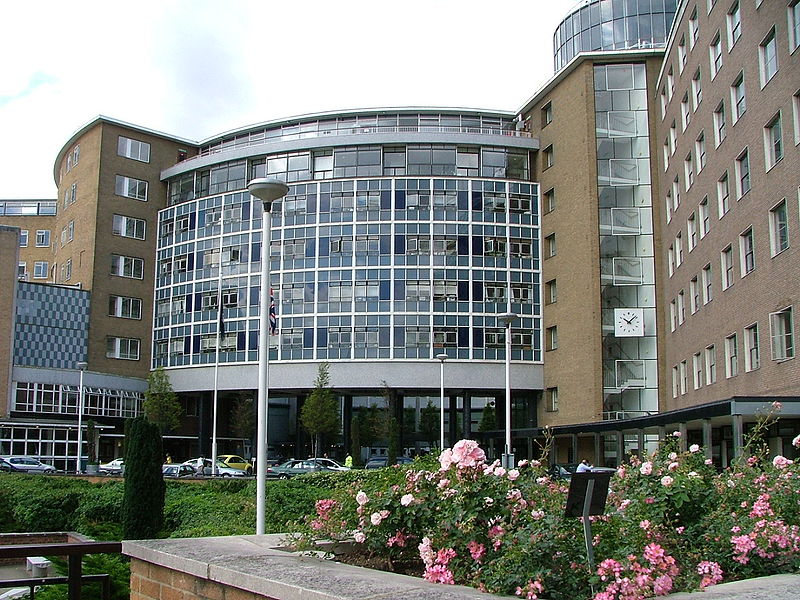
After our tour on the first day we were given our brief. What the CBBC production team wanted us to do was to generally research machinima and do some test projects to see how viable it would be as a way to produce animation sequences. We would each have an engine and work on laptops to escape the restricted BBC network. However, before any of that could take place, we had to complete a load of BBC training modules as we were classes as employees. These included: law, health and safety, competition fairness, child protection and editorial policy. All of these were extremely irrelevant to us seeing as we wouldn't even be touching a camera, but it did make you think about how things were produced behind the scenes and all the thought that has to go into a programme.
More to come!
For accomodation, the three of us - me, Dean from the Game Programming course and Alex who'd just finished his IT computing course - were put up in the BBC hostel in Queensway, West London. The BBC hostel is nice, but has a few drawbacks. Firstly, it had no internet. Secondly, the kitchens were pretty unusable. We managed to cook a few meals in them, but you certainly had to struggle, either to find the right equipment or just to find a hob or oven that actually worked. But other than that it was nice.
It was certainly nice to live in central London, although I feel like I didn't really take advantage of my situation fully. In the last week I had my longboard and did some skating in Kensington Gardens and Hyde park, and I really should have done that from the outset.
We turned up at the BBC on Monday morning and were first sent on the tour to let us get to know the Television Centre building. It's suprising how little the studios are actually used at TVC, you can understand why they want to sell the building. We also learnt that the BBC rents out its studios to other channels like Channel 4 to earn itself more money. While we were on placement they were filming the Charlotte Church show in the studio opposite our building, so we saw the sparkly set in various states of completion. We were working in the East Tower, which you can just see in this photo:

After spending a few weeks working in a TV environment, I've found out that it's very unglam. We didn't really see any celebrities - we saw some kids TV presenters and the people off of Eggheads. We did see some rehearsals and sets for shows like Mock the Week, and lunch hour could be very interesting if you just went exploring and poked your nose in all the studio viewing galleries, but Television Centre is really very functional and boring. It's also a lot smaller than it looks on TV and in photos, the massive wall you see with 'BBC Television Centre' written on it is the side wall of studio one - the biggest studio in TVC. It looks HUGE but it's only about 4 stories high.
After our tour on the first day we were given our brief. What the CBBC production team wanted us to do was to generally research machinima and do some test projects to see how viable it would be as a way to produce animation sequences. We would each have an engine and work on laptops to escape the restricted BBC network. However, before any of that could take place, we had to complete a load of BBC training modules as we were classes as employees. These included: law, health and safety, competition fairness, child protection and editorial policy. All of these were extremely irrelevant to us seeing as we wouldn't even be touching a camera, but it did make you think about how things were produced behind the scenes and all the thought that has to go into a programme.
More to come!
Wednesday, July 30, 2008
More Tutorial dropping
Importing videos from DVD into Adobe Premiere for editing purposes
Photoshop VTF export - For exporting textures so they can be read by the Source engine, which has been a temperamental nuisance so far. Unreal seems like a breeze in comparison.
So lately I've been doing lots of video editing, splicing together footage from different engines to make it seem like the same one. This way we can use the great environments of Source with the ease of use and versatile lip sync of Moviestorm.
Photoshop VTF export - For exporting textures so they can be read by the Source engine, which has been a temperamental nuisance so far. Unreal seems like a breeze in comparison.
So lately I've been doing lots of video editing, splicing together footage from different engines to make it seem like the same one. This way we can use the great environments of Source with the ease of use and versatile lip sync of Moviestorm.
Tuesday, July 22, 2008
Second Life Analysis
We're finished with the initial game engine explorations, so here are my findings on Second Life, which we've thankfully decided to abandon.
Second Life is a popular game engine to use for machinima, and this is encouraged by the Second life creators, Linden Labs.
However, second life is not very easy to use for machinima purposes. A lot of the problems reflect the problems of a real world film project. You must find an in world location, as building one yourself is out of the question unless you want to pay for land. You then have to buy or find props. Building within Second life is possible, but the controls are horrible and my existing modelling skills become useless. It is possible to import textures into second life (which you have to pay to do) but not existing models. This seems like a huge waste of potential. Searching for props is not easy to do and was very time consuming. I had to spend time earning
The other problem is that you need actors. As Second Life is an MMO of sorts, you require one person to puppet every avatar in the scene. Controlling an avatar and a camera at once is very tricky, so ideally the director would want to be apart from the scene. This means you’d need a person for every actor on screen at once, plus a director, making this a very inefficient option in terms of manpower.
The lack of scripting in Second Life means that for every take you do, the whole sequence must be acted again. This can be a disadvantage if you had everything going just right and just wanted to alter a camera angle- something that wouldn’t be a problem in an engine such as source.
Second Life also doesn’t look that great as a filming location. The residents have horrible modelling habits due to the weird builder, the textures all tile noticeably, and it’s rare to find a build with an overall art style behind it.
The main use of machinima within Second Life seems to be filming personally important events, such as in-game weddings, rather than any particularly creative endeavours. The only people I can see really wanting to pursue machinima within Second Life are the residents themselves.
I'll have to find out if I'm allowed to post up the video of the work I did as it's the BBC's intellectual property.
Wednesday, July 16, 2008
Kowloon Walled City
I found this knocking about on my portable hard drive last night. I started it before I left uni at the end of the year, and it was going pretty well. It's still very much in progress, the main issue being the pile of rubbish in the foreground needs working into.

This is from a book about Kowloon Walled City, which was incredibly interesting. When the British took control of Hong Kong, it was never certain who exactly had control over Kowloon city, so it basically became a lawless society. Despite any official laws or government controls, the city survived, and did well for itself in many ways. Although there was widespread drug use and crime, the residents also took it upon themselves to set up schools and old people's clubs. There were many successful businesses, and practicing dentists and doctors who couldn't work in mainland Hong Kong due to not having the correct paperwork. The complete lack of planning regulations led to buildings being set up wherever they would fit, and almost leaning against each other like dominoes. Utilities were haphazard, and the alleys at the base of the buildings were dark and constantly damp from the dripping pipes.

This is from a book about Kowloon Walled City, which was incredibly interesting. When the British took control of Hong Kong, it was never certain who exactly had control over Kowloon city, so it basically became a lawless society. Despite any official laws or government controls, the city survived, and did well for itself in many ways. Although there was widespread drug use and crime, the residents also took it upon themselves to set up schools and old people's clubs. There were many successful businesses, and practicing dentists and doctors who couldn't work in mainland Hong Kong due to not having the correct paperwork. The complete lack of planning regulations led to buildings being set up wherever they would fit, and almost leaning against each other like dominoes. Utilities were haphazard, and the alleys at the base of the buildings were dark and constantly damp from the dripping pipes.
Tuesday, July 15, 2008
Second Life Machinima
Well, I've taken my first steps towards making a machinima, by testing out some lip sync technology.
To make this video (please try to ignore the watermark) I simply went into Second Life and found somewhere I thought looked nice. I positioned the camera so it was facing my avatar and took a screenshot.
I then opened up Crazytalk and pasted in the image. Crazytalk lets you define certain key features of the 2D image, namely the edges of the lips and eyes. You can then record an audio track and the image will automatically lip sync. The results look pretty good, however it does limit you quite a lot by using a flat image as a base. You'd have to be careful not to overuse it and to cut it in with different shots where it wouldn't matter so much that a character wasn't obviously lip synced.
To make this video (please try to ignore the watermark) I simply went into Second Life and found somewhere I thought looked nice. I positioned the camera so it was facing my avatar and took a screenshot.
I then opened up Crazytalk and pasted in the image. Crazytalk lets you define certain key features of the 2D image, namely the edges of the lips and eyes. You can then record an audio track and the image will automatically lip sync. The results look pretty good, however it does limit you quite a lot by using a flat image as a base. You'd have to be careful not to overuse it and to cut it in with different shots where it wouldn't matter so much that a character wasn't obviously lip synced.
Wednesday, July 09, 2008
This is the BBC
As some people may be aware, I'm currently on a machinima placement with the BBC. The last couple of days have just been introduction and completing training courses, but soon we start actually getting down to business. Tomorrow we'll hopefully be given a script and then we'll each have a week or so to create a machinima of it using different engines. One of us will be on Moviestorm, one on Source, and me on Second Life. At the moment Source is looking like the most promising and flexible option for future use, but we'll have a go at everything and see what issues come up.
So for now I'll be using this blog as a drop off point for any reference I find useful in creating my Second Life machinima.
How to Alt-Zoom Camera - Camera controlling
Lip sync - Second Life Wiki - Rudimentary Lip Sync for SL
So for now I'll be using this blog as a drop off point for any reference I find useful in creating my Second Life machinima.
How to Alt-Zoom Camera - Camera controlling
Lip sync - Second Life Wiki - Rudimentary Lip Sync for SL
Machinima in Second Life - A tutorial of the whole machinima process
Thinkerer Studios - Step by step video recording and editing for SL
Noob Be Gone - Camera controls and an example of lipsynced SL machinima
Flycam - camera tool
CTRL + DEL + F1 Get rid of HUD
CTRL + DEL + D - opens up debug menu, allowing for unrestricted camera controls and some lip syncing
ALT + left click - follow a specific object or player with the camera
List of places to get animations
Wednesday, June 25, 2008
Third Year Project Idea
Some of you may know that I've recently come back from my holiday in Marmaris, Turkey, and while I was there I had a rather interesting idea for my final project. To be fair, it's not really my idea, it's Tim's, but I think he's more than happy for me to steal it from him.
The basic idea is to model an area of Leicester, but as if the predicted effects of global warming had been affecting it for quite a period of time. So, Leicester, but with a Meditteranean climate. I think this would be quite a nice idea because I'd have direct information from Leicester itself, whilst having to apply an art style, say from photos I took in Turkey.
The climate in Turkey affects far more than just the weather. Plants are different, with palm trees all over the place and the trunks of regular trees painted white, perhaps to protect them from the sun? We couldn't really work that one out. The forests are far less lush and green, and more scrubby, with trees and grasses clinging to rocks. Pavements and road surfaces in the town were always tiled brick, presumably because tarmac would melt. Buildings tended to be pastel shades, and were quite bleached by the sun. Balconies were present on pretty much every residential building in order for people to take advantage of the pleasant weather. Daily routines were also very different, with the working day starting late and finishing late, some shops staying open to about 10pm when in this country you'd expect them to close at 5.
I think this could be quite a good challenge. It would take a lot of concept art to narrow down what makes Leicester Leicester, and what makes Marmaris Marmaris. The issue then would be to combine them in a way that means Leicester is immediately recognisable, but also makes the viewer see that something isn't quite as it normally is.
I'll probably post some photos up later to illustrate some of my points a bit better.
The basic idea is to model an area of Leicester, but as if the predicted effects of global warming had been affecting it for quite a period of time. So, Leicester, but with a Meditteranean climate. I think this would be quite a nice idea because I'd have direct information from Leicester itself, whilst having to apply an art style, say from photos I took in Turkey.
The climate in Turkey affects far more than just the weather. Plants are different, with palm trees all over the place and the trunks of regular trees painted white, perhaps to protect them from the sun? We couldn't really work that one out. The forests are far less lush and green, and more scrubby, with trees and grasses clinging to rocks. Pavements and road surfaces in the town were always tiled brick, presumably because tarmac would melt. Buildings tended to be pastel shades, and were quite bleached by the sun. Balconies were present on pretty much every residential building in order for people to take advantage of the pleasant weather. Daily routines were also very different, with the working day starting late and finishing late, some shops staying open to about 10pm when in this country you'd expect them to close at 5.
I think this could be quite a good challenge. It would take a lot of concept art to narrow down what makes Leicester Leicester, and what makes Marmaris Marmaris. The issue then would be to combine them in a way that means Leicester is immediately recognisable, but also makes the viewer see that something isn't quite as it normally is.
I'll probably post some photos up later to illustrate some of my points a bit better.
Monday, June 02, 2008


Saturday, May 31, 2008
Deep Sea Discovery

This is for a speedpaint-like thing going on on a forum I visit, so I thought I'd repost it here. It didn't take very long, only an hour or two, but it doesn't technically count as a speedpaint.
Monday, May 19, 2008
The boat is finished!
I decided as I suddenly find myself with lots of free time that I would resurrect my interest in papercraft! Having built Link and lots of Spiky Babies last year, I decided to ramp up the difficulty, and built the King of Red Lions from Wind Waker.


It took me just under two weeks to build, and I'm very happy with how it came out.
Wednesday, April 16, 2008
End of the Group Project
I think it's time to write about my experience with the group project. I was hesistant about accepting a leader position as I knew it would probably involve stress and consantly wondering why I had bitten off more than I could chew, but I decided to go for it anyway. I was quite interested in being a leader purely on the organisation side, and I do seem to find myself in positions of responsibility outside of uni reasonably often. In my house I seem to organise pretty much everything money related - I don't do this because I want to boss people about but simply because I feel like if I didn't do it, nobody would.
I'm going to attempt to go through things chronologically with the aid of my Pig folder, where I basically documented every Team Pig and every Leader meeting there was. It might be interesting to type the leader meeting one up to chronicle our gradual descent into madness.
I did worry quite a bit initially for several reasons.
One: nobody really knew what they were doing. As soon as one leader had an idea, the rest of us rushed to copy them because it seemed like something we should be doing. We all had a meeting as soon as the brief was given out, we all set our blogs up and we all toured the Queen's building looking for inspiration. It took a little while to properly settle into the project and have our own ways of doing things
Two: I don't know very much. I freely admit that I am not the strongest in pretty much any discipline out there, and being faced with such a strong team was daunting. Would anyone respect my suggestions when I don't know as much as they do? Fortunately it because quickly apparent that all the leads were more than happy to explain things, and even go back to square one if necessary. It was easy to ask people for advice or explanations.
Three: As I have mentioned previously, I worry about things anyway, it tends to give me motivation to work.
Luckily for us, pretty much the first idea we thought of we decided to stick with. Our first idea was people holed up in the Queen's building, using it as a fort. Some kind of terrible circumstance had occurred, forcing people out of situations they usually controlled, and being penned into small areas, allowing nature to take over the outside world. Flooding compounds the problems faced by people in the building.
We started by researching, and producing concept art. A lot of our immediate ideas can be found in the final level. The idea of people trying to keep the trees at bay is reflected in Tom's graffiti. Jesus's idea of having the player on the walkway so they could look up and down but access neither direction is the core feature of the final level. It seems like the start of the project was years ago, and it's a nice surprise to check back and know that so many ideas were realised. Sadly though, Tom's bat people were never fully explored, maybe the world is just not ready for them.
I think researching things was one of our strong points. We chose a very accessible theme - flooding, plant life and abandoned buildings. Scott and Alex provided photos of abandoned buildings, the canal is just around the corner for things relating to slow moving water and the Bradgate park trip gave people lots of plant information. My significant other being an engineer helped no end, allowing me to provide accurate information on what would actually happen to the building should it flood, and to design a drawbridge for the inhabitants that would theoretically work.
We sat down and planned out the entire level once we had a clear idea of what we wanted. It would have been great to have made the whole thing, because it would just have expanded what we have now, but sadly we didn't have the manpower. Kitto used the plan to create a fantastic art style guide for each area, which was then used to produce concept art. Each person was assigned an area or two to concept and we starting producing asset lists based on these. I think having only a small amount of concept art really helped us, because each area had one solid vision behind it. Having too much might have made things too complicated.
I think it was around this stage in the project that I started to worry about my abilities as a leader. In my mind I didn't seem to actually be doing anything. Other leaders were managing conflicts, giving other team members a kick up the arse and generally keeping a tight grip on things. I wasn't doing any of that, the project just seemed to flow, mostly driven by the team leads, with me picking up the pieces and generally being administrative. Eventually I realised that this was what I wanted to be happening. I wasn't having to manage conflicts because there weren't any. I wasn't kicking people up the arse because everybody was getting on with it. I was quite happy to join in discussions, have everyone come up with ideas and then me write it all down and do the boring things like produce charts. This was what I'd had in mind as being leader's duties anyway, the stuff that no one really wants to do but someone has to.
With all the initial planning done, we set people test assets to check modelling skills. Once they were Ok'd, the hard bit began - the production line. For the next few weeks I felt like I had assets coming out of my ears. Everything seemed to take me far longer than it should have done and things would seem to be almost finished for ages. I think I got a bit hung up on texturing things perfectly, but I gradually got over it and got faster at producing assets. My prime time for asset production seemed to be late on Sunday nights, when my self-inflicted deadline of 'The End of the Week' loomed. As things started to appear in the blockout though, the project became more inspiring.
As Easter approched and another asset list came out, I decided to set myself the lecture theatre. It was another of those 'this will probably cause me stress and frustration, but if it works it'll be worth it' moments. Because it was so intrinsically linked to the shape of the blockout, I had to consult with Jesus in the labs a lot more. It was nice to have such communication, I could see how the level was progressing and also check that my asset fitted correctly. If we did this all again I'd encourage far more team use of the lab, as it allows everyone to give help and suggestions far more quickly and easily.
During Easter there was some drama. Alex's walkway had not fitted the blockout, so Tom had, at the request of the team as a whole, produced another one. Alex took offence and a feud broke out, which was thankfully resolved by Jesus. I felt pretty guilty that as team leader I wasn't there to deal with the issue, although I think the fact that the only real problem we had happened at a time when we had the least communication between the entire team is a testament to how well we managed generally.
And so we're almost at the current point. After Easter was the most pleasant time for me, everything was essentially finished, it just needed to be collected and polished. I could texture my infernal lecture theatre with relatively little stress, and also produce any odd assets that might be needed.
So, have I been a good leader? I'm putting myself on not sure bordering on yes. To be honest I think the group would probably have worked fine without a leader at all. We made all the big decisions together and the process flowed very nicely with input from everyone. It has been nice to be able to say 'we are doing it this way' when it comes to some things and know I'll get my way, but I definitely feel like I would describe my role as more team secretary than team leader. I tell everyone what they're doing, when they're doing it and shuffle papers afterwards, but they make the decisions about the how, why and what next. I think I've been able to adapt well to what my team needed from me, and at the end of the day we've got something to show, so I guess I must have done something right.
As a final note, a bit thank you to everyone in Team Pig for all the hard work you've put in over the last few weeks. It's been fun.
Matt: Your assets are really nice, and you were fantastic and did everything asked of you. You just need to speak up a bit more!
Scott: You weren't around all the time, but I knew you were still getting on with stuff. Your early ideas were great, and your random singing is always entertaining!
Alex: We had problems with the walkway, but you got a new lease of determination from the competition, and managed to get it to completion.
Caz: You are an asset making machine! You've improved tons and I hope you feel a lot more confident with max after all this, even if it does still misbehave.
Tom: You made a great 3d lead, you were happy to explain things and you were a fair critic, pointing out both the good and the bad in everyone's stuff.
Kitto: Your happy enthusiasm made the tough times a lot easier, and you really know your stuff when it comes to art. You were a great 2D lead.
Jesus: You have worked incredibly hard for this team. I certainly appreciate it, and I'm sure the rest of the team does too. We couldn't have done it without you.
Boss Hogg out.
I'm going to attempt to go through things chronologically with the aid of my Pig folder, where I basically documented every Team Pig and every Leader meeting there was. It might be interesting to type the leader meeting one up to chronicle our gradual descent into madness.
I did worry quite a bit initially for several reasons.
One: nobody really knew what they were doing. As soon as one leader had an idea, the rest of us rushed to copy them because it seemed like something we should be doing. We all had a meeting as soon as the brief was given out, we all set our blogs up and we all toured the Queen's building looking for inspiration. It took a little while to properly settle into the project and have our own ways of doing things
Two: I don't know very much. I freely admit that I am not the strongest in pretty much any discipline out there, and being faced with such a strong team was daunting. Would anyone respect my suggestions when I don't know as much as they do? Fortunately it because quickly apparent that all the leads were more than happy to explain things, and even go back to square one if necessary. It was easy to ask people for advice or explanations.
Three: As I have mentioned previously, I worry about things anyway, it tends to give me motivation to work.
Luckily for us, pretty much the first idea we thought of we decided to stick with. Our first idea was people holed up in the Queen's building, using it as a fort. Some kind of terrible circumstance had occurred, forcing people out of situations they usually controlled, and being penned into small areas, allowing nature to take over the outside world. Flooding compounds the problems faced by people in the building.
We started by researching, and producing concept art. A lot of our immediate ideas can be found in the final level. The idea of people trying to keep the trees at bay is reflected in Tom's graffiti. Jesus's idea of having the player on the walkway so they could look up and down but access neither direction is the core feature of the final level. It seems like the start of the project was years ago, and it's a nice surprise to check back and know that so many ideas were realised. Sadly though, Tom's bat people were never fully explored, maybe the world is just not ready for them.
I think researching things was one of our strong points. We chose a very accessible theme - flooding, plant life and abandoned buildings. Scott and Alex provided photos of abandoned buildings, the canal is just around the corner for things relating to slow moving water and the Bradgate park trip gave people lots of plant information. My significant other being an engineer helped no end, allowing me to provide accurate information on what would actually happen to the building should it flood, and to design a drawbridge for the inhabitants that would theoretically work.
We sat down and planned out the entire level once we had a clear idea of what we wanted. It would have been great to have made the whole thing, because it would just have expanded what we have now, but sadly we didn't have the manpower. Kitto used the plan to create a fantastic art style guide for each area, which was then used to produce concept art. Each person was assigned an area or two to concept and we starting producing asset lists based on these. I think having only a small amount of concept art really helped us, because each area had one solid vision behind it. Having too much might have made things too complicated.
I think it was around this stage in the project that I started to worry about my abilities as a leader. In my mind I didn't seem to actually be doing anything. Other leaders were managing conflicts, giving other team members a kick up the arse and generally keeping a tight grip on things. I wasn't doing any of that, the project just seemed to flow, mostly driven by the team leads, with me picking up the pieces and generally being administrative. Eventually I realised that this was what I wanted to be happening. I wasn't having to manage conflicts because there weren't any. I wasn't kicking people up the arse because everybody was getting on with it. I was quite happy to join in discussions, have everyone come up with ideas and then me write it all down and do the boring things like produce charts. This was what I'd had in mind as being leader's duties anyway, the stuff that no one really wants to do but someone has to.
With all the initial planning done, we set people test assets to check modelling skills. Once they were Ok'd, the hard bit began - the production line. For the next few weeks I felt like I had assets coming out of my ears. Everything seemed to take me far longer than it should have done and things would seem to be almost finished for ages. I think I got a bit hung up on texturing things perfectly, but I gradually got over it and got faster at producing assets. My prime time for asset production seemed to be late on Sunday nights, when my self-inflicted deadline of 'The End of the Week' loomed. As things started to appear in the blockout though, the project became more inspiring.
As Easter approched and another asset list came out, I decided to set myself the lecture theatre. It was another of those 'this will probably cause me stress and frustration, but if it works it'll be worth it' moments. Because it was so intrinsically linked to the shape of the blockout, I had to consult with Jesus in the labs a lot more. It was nice to have such communication, I could see how the level was progressing and also check that my asset fitted correctly. If we did this all again I'd encourage far more team use of the lab, as it allows everyone to give help and suggestions far more quickly and easily.
During Easter there was some drama. Alex's walkway had not fitted the blockout, so Tom had, at the request of the team as a whole, produced another one. Alex took offence and a feud broke out, which was thankfully resolved by Jesus. I felt pretty guilty that as team leader I wasn't there to deal with the issue, although I think the fact that the only real problem we had happened at a time when we had the least communication between the entire team is a testament to how well we managed generally.
And so we're almost at the current point. After Easter was the most pleasant time for me, everything was essentially finished, it just needed to be collected and polished. I could texture my infernal lecture theatre with relatively little stress, and also produce any odd assets that might be needed.
So, have I been a good leader? I'm putting myself on not sure bordering on yes. To be honest I think the group would probably have worked fine without a leader at all. We made all the big decisions together and the process flowed very nicely with input from everyone. It has been nice to be able to say 'we are doing it this way' when it comes to some things and know I'll get my way, but I definitely feel like I would describe my role as more team secretary than team leader. I tell everyone what they're doing, when they're doing it and shuffle papers afterwards, but they make the decisions about the how, why and what next. I think I've been able to adapt well to what my team needed from me, and at the end of the day we've got something to show, so I guess I must have done something right.
As a final note, a bit thank you to everyone in Team Pig for all the hard work you've put in over the last few weeks. It's been fun.
Matt: Your assets are really nice, and you were fantastic and did everything asked of you. You just need to speak up a bit more!
Scott: You weren't around all the time, but I knew you were still getting on with stuff. Your early ideas were great, and your random singing is always entertaining!
Alex: We had problems with the walkway, but you got a new lease of determination from the competition, and managed to get it to completion.
Caz: You are an asset making machine! You've improved tons and I hope you feel a lot more confident with max after all this, even if it does still misbehave.
Tom: You made a great 3d lead, you were happy to explain things and you were a fair critic, pointing out both the good and the bad in everyone's stuff.
Kitto: Your happy enthusiasm made the tough times a lot easier, and you really know your stuff when it comes to art. You were a great 2D lead.
Jesus: You have worked incredibly hard for this team. I certainly appreciate it, and I'm sure the rest of the team does too. We couldn't have done it without you.
Boss Hogg out.

Monday, April 14, 2008
Digital Masterpiece
Woohoo! Finished. This was quite fun to do, apart from the wheat, which was a pain.
Wheatfield with Cypresses, by Van Gogh.
Original:

Mine:
Wheatfield with Cypresses, by Van Gogh.
Original:

Mine:

Saturday, April 05, 2008
God this task is hard
I stated earlier that art is successful if it provokes a reaction in people. But what if you have a piece of tat that simply provokes a reaction of horror at its complete lack of skill, instead of evoking the emotion it was supposed to? Look at this... thing, dredged up from the wonderful place that is deviantart.

It's clearly trying to portray some kind of melancholy, but instead all you see is the flaws. The background perspective is strange to say the least. There seems to be some kind of vanishing point going on with the trees but the water just spreads up the page instead of vanishing anywhere. There is no interaction between the character and the water she is standing in - the character herself seems to have a spine like a poker and only possesses one finger. I could go on. But is my distaste the same as that against works of modern art?
I think the severe backlash against work such as Hirst and Emin's is because people are feeling the emotions they are meant to be feeling when they experience the work, and they don't like what they feel. A lot of modern art does not adhere to typical 'right and wrong' rules like perspective because they may be exploring a different area, so they cannot be assessed on the same criteria.
The criteria for good and bad art needs to depend on what the work was trying to achieve. If it achieves the mood and evokes the feeling it was meant to, then it is a success. You can then go on to examine other points such as following rules of perspective and colour theory. Judging art by set rules is impossible, both because art constantly challenges rules themselves and because criteria that apply to one piece will not apply to another. How can you mark a sculpture to the same set of rules as a 2D sketch? They require completely different levels of viewer interaction.
It is at this point where the 'it' factor comes in again, as mentioned previously. So I suppose a lot of things come into play when assessing whether something is good or bad.
Does it achieve the mood/ portray the thing it was meant to?
Does it adhere to rules of art?
Does it have the 'it' factor?
Do I like it?
All these things must contribute, but it is hard to say how much emphasis should be put on each point. "Do I like it?" is perhaps the least important point for neutrally judging a piece of art, but it is a diffcult question to avoid. The 'it' factor should perhaps not come into play, but inevitably does in giving a piece impact. The implementation of the rules of art and the achievement of the mood the piece was supposed to portray are probably the most important factors. They also intertwine with each other. A piece like the one above can have a mood it is trying to convey, but may be let down its adherance to artistic rules. On the other hand, a piece may be technically very good, but lack any particular mood direction.
Ultimately a piece needs to do what it's supposed to, which is where yet another problem comes in, because who gets to decide that?
It's clearly trying to portray some kind of melancholy, but instead all you see is the flaws. The background perspective is strange to say the least. There seems to be some kind of vanishing point going on with the trees but the water just spreads up the page instead of vanishing anywhere. There is no interaction between the character and the water she is standing in - the character herself seems to have a spine like a poker and only possesses one finger. I could go on. But is my distaste the same as that against works of modern art?
I think the severe backlash against work such as Hirst and Emin's is because people are feeling the emotions they are meant to be feeling when they experience the work, and they don't like what they feel. A lot of modern art does not adhere to typical 'right and wrong' rules like perspective because they may be exploring a different area, so they cannot be assessed on the same criteria.
The criteria for good and bad art needs to depend on what the work was trying to achieve. If it achieves the mood and evokes the feeling it was meant to, then it is a success. You can then go on to examine other points such as following rules of perspective and colour theory. Judging art by set rules is impossible, both because art constantly challenges rules themselves and because criteria that apply to one piece will not apply to another. How can you mark a sculpture to the same set of rules as a 2D sketch? They require completely different levels of viewer interaction.
It is at this point where the 'it' factor comes in again, as mentioned previously. So I suppose a lot of things come into play when assessing whether something is good or bad.
Does it achieve the mood/ portray the thing it was meant to?
Does it adhere to rules of art?
Does it have the 'it' factor?
Do I like it?
All these things must contribute, but it is hard to say how much emphasis should be put on each point. "Do I like it?" is perhaps the least important point for neutrally judging a piece of art, but it is a diffcult question to avoid. The 'it' factor should perhaps not come into play, but inevitably does in giving a piece impact. The implementation of the rules of art and the achievement of the mood the piece was supposed to portray are probably the most important factors. They also intertwine with each other. A piece like the one above can have a mood it is trying to convey, but may be let down its adherance to artistic rules. On the other hand, a piece may be technically very good, but lack any particular mood direction.
Ultimately a piece needs to do what it's supposed to, which is where yet another problem comes in, because who gets to decide that?
Monday, March 31, 2008
Bradgate Park Painting
 I just finished this, and I'm pretty darn happy with it!
It's interesting to compare this to the previous photoshop picture I put on here. I colour picked on this one, whereas I didn't on the previous one. Looking back, the burnt house picture seems pretty cartoonish with its colour usage.
Photoshop is still relatively new to me in terms of my whole artistic education, and I'm still finding it tricky to translate some of my skills into a new medium. I feel like you don't really get much feedback from digital painting, and strange as it sounds, it bugs me a little that it does whatever you tell it.
Wednesday, March 26, 2008
Good and Bad
OK, I'm going to start tackling this one. I didn't want to start this as I felt a lot of it had been said in the initial talk we were given about it. Unlike creativity, good and bad can't really be researched very easily, so this is going to have to mostly be my own thoughts. I'm ususally pretty wary of writing down purely my own thoughts with no backup when it comes to factual matters, a mindset impressed on me by taking history A level I fear.
The first thing I think I should tackle is what good and bad even mean. I looked both up and they each have about 30 different uses each, amusingly the first definition for bad was 'not good in any manner or degree'- very helpful. But it basically breaks down to good always meaning positive and bad always meaning negative.
These words express the way humans feel the need to simplify the world around them. Right and wrong. Heaven and Hell. But it is important to keep in mind that these are entirely false constructs. All ideas of good and bad are learnt. Growing up, we rely on others to teach us what is right and what is wrong, and we absorb this information instinctively because it makes evolutionary sense to learn from the mistakes of those who have gone before us.
When you think about it, we take a lot of what we are told for granted. We simply don't have the time to test everything we are told for ourselves, so we weigh it up with what we know from our own personal experiences, and make a judgement on how likely it is to be correct. As Newton put it "If I have seen further, it is by standing on the shoulders of giants." Do you know from your own personal experience that the Earth revolves around the Sun? I highly doubt it. But you have heard from enough reputable sources that it does, and so far no one has come to you with any evidence saying otherwise.
So, back to good and bad. We are learning all the time, and our collective idea of what is good and what is bad in terms of anything must be changing all the time as human knowledge and experimentation changes. The impressionists were widely slated when they first exhibited their work - a clear sign that the wider world thought of them as "bad". But in the present day their work is highly respected and seen as aesthetically pleasing, signs of it being thought of as "good". So good and bad are transient concepts, and we can only really assess anything as being good or bad in relation to today's current values of them.
The first thing I think I should tackle is what good and bad even mean. I looked both up and they each have about 30 different uses each, amusingly the first definition for bad was 'not good in any manner or degree'- very helpful. But it basically breaks down to good always meaning positive and bad always meaning negative.
These words express the way humans feel the need to simplify the world around them. Right and wrong. Heaven and Hell. But it is important to keep in mind that these are entirely false constructs. All ideas of good and bad are learnt. Growing up, we rely on others to teach us what is right and what is wrong, and we absorb this information instinctively because it makes evolutionary sense to learn from the mistakes of those who have gone before us.
When you think about it, we take a lot of what we are told for granted. We simply don't have the time to test everything we are told for ourselves, so we weigh it up with what we know from our own personal experiences, and make a judgement on how likely it is to be correct. As Newton put it "If I have seen further, it is by standing on the shoulders of giants." Do you know from your own personal experience that the Earth revolves around the Sun? I highly doubt it. But you have heard from enough reputable sources that it does, and so far no one has come to you with any evidence saying otherwise.
So, back to good and bad. We are learning all the time, and our collective idea of what is good and what is bad in terms of anything must be changing all the time as human knowledge and experimentation changes. The impressionists were widely slated when they first exhibited their work - a clear sign that the wider world thought of them as "bad". But in the present day their work is highly respected and seen as aesthetically pleasing, signs of it being thought of as "good". So good and bad are transient concepts, and we can only really assess anything as being good or bad in relation to today's current values of them.
Monday, March 24, 2008
Game Design and Social Networking
I thought I'd write up the lecture we had the Wednesday we broke up, seeing as I took plenty of notes, and as it was cool and interesting.
The lecture was given by Guy Parsons, who currently develops online communities and ARGs (Alternate Reality Games). More on those later.
At university, we have the time and freedom to create new things. We can take risks that we might not be able to take were we in employment, and we can create small games that might be a commercial flop, because it doesn't matter.
Guy gave a few examples of small games that push the boundaries like this. There are some links in his corresponding blog post.
A lot of them looked pretty cool. Toblo was designed by students and has a physics engine that allows players to use the environment as weapons. One multiplayer game let users create maps in MS paint and then import them into the game world. There was even a way to use Excel spreadsheets as a game engine.
Building up a community around your game was a factor that Guy mentioned several times. If you have a loyal following, albeit a small one, it bring a lot of benefits. You keep your game new and interesting, both from your fans bringing in new players and from user generated content. You have an eager audience for anything new you might produce, and you can also use the visitors to generate income, either through charging for the game itself or through advertising.
Games should draw inspiration from anything and everything. Start with something you perhaps wouldn't associate with games, like a fine artist. An Escher inspired game called Echochrome is currently in development for the PSP and PS3, with the environment changing shape as you rotate the camera, allowing you to continue across the terrain. It's crazy stuff.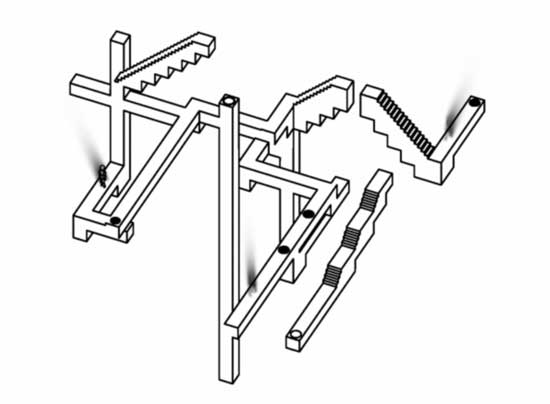
The bold and memorable art style of Team Fortress 2 is a good example of casting a wider net for inspiration. The Valve team were influenced by 1920s illustrations: here are some of their reference images with notations from their slide deck about the design process behind TF2. The slide show itself is a really interesting read, and goes into loads of mathematical shader detail. The 'fan reaction' section is quite fun, with loads of different game dev teams cosplaying as the TF2 classes.
These weren't actually in the lecture as Guy hadn't managed to find the images, but he later put them up on his blog:


An important thing to remember when coming up with a new idea for a game is that EVERYTHING is a game. This is nicely illustrated by Chore Wars, an online game where you compete against your housemates to see who can do the most chores and therefore earn the most points. If you can attach a score to it, anything becomes a game. Another example given was a website where you could download goals to aim for when running.
More examples of cool little games:
squidi.net - currently has 300 different types of game mechanics
Defcon - those who were at Gamecity will have probably seen this one. Basically it's the doom screen from every movie where there's a terrible war and the nukes are going off and everybody dies. You can't really win
Desktop tower defence - the popular Tower Defence custom game from Warcraft 3, but in flash game format set on a desktop
Kingdom of Loathing- An RPG that takes nothing about itself seriously. I saw some Kingdom of Loathing graffiti once in a toilet in Camden. A good example of the hardcore nature of KoL fans.
Bejewelled - A casual game where you have to line up 3 or more gemstones of the same type to get them to disappear. Casual games are tipped to be the next big thing, and this is a very popular one
Peggle - Another popular casual game
Scrabulous - Facebook application which is a Scrabble clone. Scrabble are sueing the creators for copyright infringement
Line Rider - The little dude will ski down the line you draw
Audiosurf - If you've been anywhere near Joel in the last couple of weeks you'll know about this game. It's like a cross between Guitar Hero and a racing game, and it can use any song in your library to generate a race track. It's available to buy on Steam.

A relatively new and immersive type of game is the ARG, or Alternate Reality Game. ARGs present a game scenario which ties in closely with real life. There may be blogs, social networking profiles for characters, coded websites, real world location drops, and even interactions with actors posing as characters within the game scenario. The players of the ARG must work together to solve what is going on in the scenario, so the sense of community is strong.
Guy described it as for people who like stalking other people on the internet, only not as sinister.
The conclusions from the lecture were these:
The lecture was given by Guy Parsons, who currently develops online communities and ARGs (Alternate Reality Games). More on those later.
At university, we have the time and freedom to create new things. We can take risks that we might not be able to take were we in employment, and we can create small games that might be a commercial flop, because it doesn't matter.
Guy gave a few examples of small games that push the boundaries like this. There are some links in his corresponding blog post.
A lot of them looked pretty cool. Toblo was designed by students and has a physics engine that allows players to use the environment as weapons. One multiplayer game let users create maps in MS paint and then import them into the game world. There was even a way to use Excel spreadsheets as a game engine.
Building up a community around your game was a factor that Guy mentioned several times. If you have a loyal following, albeit a small one, it bring a lot of benefits. You keep your game new and interesting, both from your fans bringing in new players and from user generated content. You have an eager audience for anything new you might produce, and you can also use the visitors to generate income, either through charging for the game itself or through advertising.
Games should draw inspiration from anything and everything. Start with something you perhaps wouldn't associate with games, like a fine artist. An Escher inspired game called Echochrome is currently in development for the PSP and PS3, with the environment changing shape as you rotate the camera, allowing you to continue across the terrain. It's crazy stuff.
The bold and memorable art style of Team Fortress 2 is a good example of casting a wider net for inspiration. The Valve team were influenced by 1920s illustrations: here are some of their reference images with notations from their slide deck about the design process behind TF2. The slide show itself is a really interesting read, and goes into loads of mathematical shader detail. The 'fan reaction' section is quite fun, with loads of different game dev teams cosplaying as the TF2 classes.
These weren't actually in the lecture as Guy hadn't managed to find the images, but he later put them up on his blog:
An important thing to remember when coming up with a new idea for a game is that EVERYTHING is a game. This is nicely illustrated by Chore Wars, an online game where you compete against your housemates to see who can do the most chores and therefore earn the most points. If you can attach a score to it, anything becomes a game. Another example given was a website where you could download goals to aim for when running.

More examples of cool little games:
squidi.net - currently has 300 different types of game mechanics
Defcon - those who were at Gamecity will have probably seen this one. Basically it's the doom screen from every movie where there's a terrible war and the nukes are going off and everybody dies. You can't really win
Desktop tower defence - the popular Tower Defence custom game from Warcraft 3, but in flash game format set on a desktop
Kingdom of Loathing- An RPG that takes nothing about itself seriously. I saw some Kingdom of Loathing graffiti once in a toilet in Camden. A good example of the hardcore nature of KoL fans.

Bejewelled - A casual game where you have to line up 3 or more gemstones of the same type to get them to disappear. Casual games are tipped to be the next big thing, and this is a very popular one
Peggle - Another popular casual game
Scrabulous - Facebook application which is a Scrabble clone. Scrabble are sueing the creators for copyright infringement
Line Rider - The little dude will ski down the line you draw
Audiosurf - If you've been anywhere near Joel in the last couple of weeks you'll know about this game. It's like a cross between Guitar Hero and a racing game, and it can use any song in your library to generate a race track. It's available to buy on Steam.
A relatively new and immersive type of game is the ARG, or Alternate Reality Game. ARGs present a game scenario which ties in closely with real life. There may be blogs, social networking profiles for characters, coded websites, real world location drops, and even interactions with actors posing as characters within the game scenario. The players of the ARG must work together to solve what is going on in the scenario, so the sense of community is strong.
Guy described it as for people who like stalking other people on the internet, only not as sinister.
The conclusions from the lecture were these:
- University is a time where you have 3 years with no commercial constraints, and is a perfect time for experimentalism, innovation and creativity. If you come up with an idea, prototype it.
- Inspiration comes from everywhere - life is a game. Pay attention to everyday life and draw inspiration from it. Because you're pretending, that makes it fun.
Subscribe to:
Posts (Atom)