Sunday, March 04, 2007

Let's draw retarded Pokemon

So I did.
Ah how I love somethingawful.com :)

Wednesday, February 28, 2007

Week 21: Where do you want to go and how do you want to get there?

OK, so it's time to reflect on the course so far and then think about what I want from it in the future. Let's break it down into modules for what I've done so far.

Drawing: I would say drawing is my strongest area. I do work hard at it, but I also really enjoy being able to just play and know that it's helping me get somewhere. I've ventured into photoshop for colouring things which I was hesitant to do before. My media usage has become a lot wider because I'm not hampered by project deadlines like I was in art college.
Hopefully in the future I'll go more into the sculpture and plastics side of things and try making some 3D characters. I think it'd help me a lot and show potential employers that I'm pretty versatile.

3D Studio Max: I've found Max pretty tricky to get to grips with, but I am learning something with every project we do. I get a little worried sometimes because it doesn't come as easily to me as it does to others in the class and because I'm not as enthusiastic about it as I could be. I think I'm afraid that I'm not good enough when really I've been progressing a lot and have a lot to show for the past year.
I think my personal confidence is what's holding me back in this module, so I need to sit down and do some tutorials on the K drive as well as some from my 3D Studio Max Bible. Quite looking forward to the group projects to see how well co-operation and management works out, as they will be important skills for the future.

Art Style Guide: I'm going to lump the schedules and specifications in here too, as it's all document management. Although a bit tedious I can see the need for these documents in the industry. I don't feel like I've had a proper crack at the specifications having seen a second year example, but I'm going to try and do them in an instructional style for the van and resubmission of the tree. Timetables I feel have gone well and I have stuck to reasonably.
Obviously there will be a lot more focus on this area next year and I feel I do need a few more goes at it before I can really say whether I know what I'm doing or not, but I don't think I have any specific problems so far.

Blogs: Some of the blog topics I have loved, some of them I have found confusing and/or hard to write about. I don't think I have trouble with the blogs, but I wouldn't say I excel at them either. I like the way that I've started using it as a more social and fun thing by posting whatever pops into my head and by adding the blog to my facebook. It makes it easier to write in.

So there we go. I'd say I'm doing pretty well, although I need to give myself a kick up the bum with regards to using Max more. Now for the future:

When I leave here I want to have a strong set of valuable skills appropriate for the games industry. I'm currently really happy that if I keep working hard in all aspects of the course that I can achieve this. I'm happy on the course and feel like I know what is expected of me and that there are achievable goals I can work towards. The only thing I would say I want from the course is more focus on 3D sculpture in the drawing classes as I feel that this could help broaden my portfolio and provide more research for the Max work. But Chris has already mentioned all this so hopefully it will be in the pipeline for next year.

Tuesday, February 27, 2007

I went to see Hot Fuzz at the weekend!
Truly cinema cannot get any better than Simon Pegg drop kicking an old woman.


Brilliant film with some great references to Shaun of the Dead. Everyone go see it now!

Sunday, February 18, 2007


Week 20: Creativity

What is creativity? Creativity is the ability to think of new and different ideas that are also useful and applicable to something. For me creativity always seems to manifest itself at about 2 in the morning when I am trying to go to sleep. My mind wanders as I fall asleep and stumbles on things that I always need to get drawn pretty immediately or I forget them.

Creativity is all around us. Every man made object we see was designed or planned by somebody at some point. It's easy to forget about.

I don't think creativity is necessarily hindered by technical constraints, it just helps to shape it. In the sound lecture Pip mentioned that it was a pity in a way that games now had a more wide ranging musical voice as they had lost the identity the music had in the NES era. Limits can force you to a conclusion you might not have otherwise reached, and doesn't always mean the work has to suffer.

I think everybody in a game 'does' creativity, although some may be more limited in how they can express it. A good portion of creativity for the game has already been done in the design document and it's up to artists and programmers to interpret their individual briefs as creatively as they can while staying within its boundaries and making sure it achieves what it needs to.

As an artist I'd think that most of my creative exploration would take place before drawing or modelling anything. I've been having a lot of fun in the plastics lab and print room lately so perhaps I might have a play with ideas in different media before properly beginning a project. In drawing I could use different types of media to convey an idea or be creative with the ideas themselves. At the moment I'm pretty fond of mashing together two different project ideas like hands and bits of heated up foil and seeing what comes out.

What does creativity look like? This is such a tricky question because as I said earlier absolutely anything produced involves creativity. However the quality and breadth of creativity is a varied thing. Creativity can be housed in a brand identity as it encompasses the setting, characters and art style of a game. It can also be found in the art style, programming and the gameplay.

I really like the creativity found in the Sly Cooper series by Sucker Punch. The characters are anthropomorphic animals, using the idea of familiar attributes that can be easily related to by a wide audience. Animal characters are often found in fairy tales or fables. The idea of playing as a thief is also creative and makes a change from the fairly standard fighter character.
Creative programming can be found in FarCry, where enemies use military tactics to surround the player and try to kill them.
For creative graphics and visual style I would give the example of Psychonauts. Wacky character designs with definite shapes and also a very lateral way of representing abstract concepts (actual baggage for emotional baggage and small men screaming "NO!" at you to destroy errant thoughts) make this a very unique game to play.
Finally for gameplay I would give the example of Guitar hero. Being creative in taking the idea of rhythm games and the secret dream of just about everyone to be a rock star, and combining them to make a great game. Games which come with their own standard control system like Eyetoy or Donkey Konga always seem that little bit more novel.

Thursday, February 15, 2007

I feel like some of my posts lately have been slightly controversial and have made people disagree with me. Which is fine really, a debate is a good thing to have. But to counteract this argumentative tone, I have decided to post pictures of kittens!


Awwwww

Sunday, February 11, 2007

Week 19: Life changing or career building?

This week's task is a pretty tough one to get info on. The main questions is whether games companies want fresh arts graduates with open minds who can be taught things or whether they want graduates who have taken games orientated courses and have learnt modelling, texturing, animating or concept drawing skills.

I've searched through the jobs postings on gamasutra and all of the ar
ts ones are asking for experience in max and photoshop, as you would expect, but they do also want traditional art skills.

I found a pretty good interview on gamasutra with Doug Tennapel, the creator of Earthworm Jim.

Tennapel says he likes everything Insomniac does, as well as the game Psychonauts which I am inclined to agree with. I liked the way Psychonauts was pushing the exaggeration of the characters, but I did feel that this meant that some looked like they were in a different style to others. Some of the campsite kids have a wildly different look to other ones, but on the whole the designs are brave and work well.

One of the main messages from the interview was that videogames companies need to be hiring artists who have more of a broad art background with experience in skills like colour theory and anatomy. He claims that instead many are being blinded by the details that artists can achieve

"Like for instance, if a guy maybe renders with his pencil really well, puts good shading on a creature, but his anato
my is completely wrong…they hire him because he tricked them with his cool detail, even though the foundation of his drawing is weak."

It's good to see that a message like this is coming from someone within the industry, asking for all round applicable art skills. I feel that the balance between art and modelling is a delicate one, and one that this course handles well. The art skills we get taught by Chris in the drawing module are applicable to all types of art. Perspective, colour theory and anatomy are universal skills which perhaps are not as prevalent in the games industry as they should be.

But perhaps neither is original and creative thinking, which would be more likely to come from art course graduates. My art foundation certainly taught me how to think outside the box and redefine words like 'drawing'. A drawing is not pencil lines on a piece of paper, it is any type of information about anything presented in any kind of way. So if I were studying oranges for example then yes I might do a traditional drawing but I might try cutting it up and printing with it, rolling it in paint an
d then on paper, casting it, trying to replicate its colour, warping its shape, measuring it and writing down its stats, rolling it and recording how it moves or smashing it on a canvas.

All these are legitimate drawing techniques, which I don't think some people on this course really understand, perhaps because they weren't expecting to have to address them. It would explain the slighty underwhelmed response to the exhibition the other week, which was full of interesting abstract work.
So I've basically come the long way round to saying I think this course has it right. The industry is asking for specific skills like 3D Studio Max and Photoshop which we can deliver but hopefully with some prodding we can deliver a more broad understanding of artistic techniques and skills which can help expand the horizons of the games industry as well as providing the more immediate benefit of accuracy and understanding.

Monday, February 05, 2007

I have a new hobby. It's called papercraft.


Expect to see my print budget disappear very rapidly

Friday, February 02, 2007

Week 18 Sound for Games

I thought it was a bit of a random addition to the bottom of the list of questions to get you started, but it seems that 'Good Times' by Nile Rodgers/Bernard Edwards could actually be one of the most influential pieces of music from the 20th century. Wikipedia informs me that it is one of the most sampled tracks in musical history, and gives a long list of artists who used it, including Queen, Blondie, The Clash, the Beastie Boys, Busta Rhymes, De La Soul and of course DJ Jazzy Jeff and The Fresh Prince (hee hee). The song is also ranked #224 on Rolling Stone's list of the 500 Greatest Songs of All Time. So there you have it. So it is of course very important that someone as influential as Nile Rodgers says:
'That's when I got hooked, and then I got involved in some other titles and the next think you know, I decided one day that I was taking all the things I had on my walls in my office down and replacing it with all the video game media that I had.' That's some pretty heavy stuff. One of the musicians who produced one of the most sampled tracks in music is giving a big thumbs up to video games and all media assosciated with them.

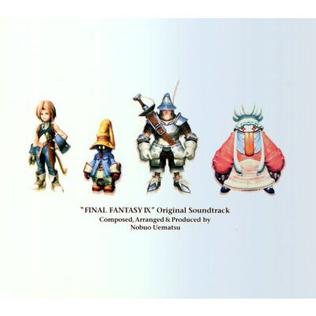
So, game music. I have the odd game song on my playlist, and I also have the entire soundtrack to Final Fantasy 9, by Nobuo Uematsu. Uematsu is a very important game music composer, and has worked on many of the Final Fantasy games ranging from 4 to the latest one, 13, although his work on 9 was the last soundtrack he did alone. The music for 9 is fantastic, the musical styles and feels change depending on where you are and what you're doing in the game. One of the most satisfying sonic moments for me was when you first get the airship in FF9, and you are suddenly free to explore the entire map, no longer hindered by sea or mountain ranges. The music that starts up as you begin to fly your airship is fun and uplifting, with lots of guitar riffs to remind you just how cool this is.

Another notable game musician is Martin Galway, who began his career in 1983 making music for his friends' games. They approached Ocean Software who liked the game and were also impressed by Galway's music. Galway was lent a state of the art composition unit and proceeded to work for the company. His work spanned many games and genres and was pushing the boundaries of technology wherever it could, using multiple instruments in themes for examples. Galway remained on top of new technology for the rest of his career, introducing sampled sounds on the Commodore.

I found a great article on Gamasutra about the music composition for Myst III: Exile, done by Jack Wall. The article is a reflective diary about the production, and how the composer immerses himself in the atmosphere and music of the previous two games before attempting his own version. It really made me think about how much work goes into game music and how similar it is to art design. You have to have a united, yet varied sound which enhances the game experience without distracting the player.

I also have some music directly influenced by games, be it fan music or a band's tribute to certain games, such as the Legend of Zelda theme by System of a Down. I also can't remember where I read this, but artists are also starting to make music using old gameboys and old video game sound chips to produce tracks, as well as manipulating the chips to produce sound they normally wouldn't be able to. It's called Bitpop.

Tuesday, January 30, 2007

The Game


I have decided that it is time to explain The Game. I have already begun spreading it around uni teaching it as it was taught to me by Chris and as was taught to him and so on and so on.


The aim of The Game is to forget you are playing The Game. If you remember you are playing The Game, you have lost The Game. You cannot win The Game. No one can. Everyone in the world is playing The Game, just that some of them might not know yet. If you remember you are playing The Game, and lose The Game, it is your duty to inform everyone around you, and irritate them by making them lose too. There is a five minute grace period after someone loses in which no one else is allowed to lose, in order to let everyone fully forget about The Game.


You will find after a while playing The Game that certain things will trigger losing. These can include: seeing the person who taught you The Game, certain objects - for me bananas, melons or cheesecake, seeing Lost on TV, hearing a song by rapper The Game or talking about any kind of game.


Enjoy :)

Sunday, January 28, 2007

Week 17: Game Engines

A game engine is the core software of a game with real time graphics. They will control tasks such as rendering the graphics, physics, animation, scripting and networking, and can help make game construction easier, faster and cheaper.

Developers can choose to construct their own game engine to suit their needs or can purchase an existing engine such as the Unreal engine. Developers can also purchase 'middleware', engines which can be tacked on to an existing engine to provide a different function. Examples of these are the Havok physics engine, which can be used to control ragdoll physics, and SpeedTree, which can procedurally generate trees once given examples or specifications. Both of these examples of middleware can save developers time.
Developers can also develop their own middleware and swap and share amongst each other. I seem to remember Naughty Dog and Insomniac sharing their weapon engine and environment creation engine.

Subtractive and Additive are terms used to describe the way a level is created within the game engine. The Unreal Editor for example uses subtractive creation. The game level begins as a solid block and the user uses brushes to carve away shapes. The brushes have many different qualities, and can add solid, semisolid or nonsolid objects to the game level. However this method can cause problems and lead to crashes in the editor due to the way the brush effects are memorised. Using mesh objects such as those created in 3D studio max can help to solve the problem as they are easier to process.
An additive level editor begins as a blank space and is then built up rather than being carved out.

The advantages of using an existing engine are that you know it works, it's ready to go and only needs minor adjustments, and you can focus on the artistic elements of your game. However, the engine may not do exactly what you want it to and your game will have to work around the limits of the engine with its gameplay. If you build your own engine, you can focus on exactly what you want your game to achieve, can make the code as complex or simple as you want and have the option of selling the engine later, ensuring more money from the game.

The key issues for next gen engines appear to be based around light and shadow. New dynamic shadow and light mapping is being developed for the Source engine, and the Unreal 3 engine site boasts of its support for four methods of shadowing techniques .

Tuesday, January 23, 2007

I was thinking earlier about how you get a lot of film to video game conversions, and a lot of book to film conversions, but not a lot of book to video game conversions. The only ones I can really think of are the Hitchhikers guide to the Galaxy text adventure game, and a couple of Discworld games. But then again, Hitchhikers was never really one format to begin with, and Terry Pratchett is notoriously picky about who can do what with his books.
I say this because I was thinking about how the Hungry Cities series of books would work as a game.

I've just finished reading them, and they honestly blew me away. They're about a post-apocolyptic world where leaders have decided to move their cities around to keep them from being attacked. The cities have huge jaws on the front to devour smaller towns or static settlements. The materials they gather are then sorted by people in the gut and used to extend or maintain the city. Due to the movement of the cities, the earth is constantly churned up, and no vegetation grows. A group called the anti-traction league have settlements in the Himalayas, and want to restore the Earth to its green state.

There is a lot of scope for a game here, either sim city style, managing your moving city: Where do I use the new materials? Where should I hunt next? Who should I trade with?
Or perhaps as an adventure with the two main characters, Hester and Tom. Between the first and second books they go adventuring on the Bird Roads - paths taken by trading airships. This leaves a lot of scope for players to visit all the cities they could wish to without upsetting any plot balance. You could play through the first book and then adventure in the Bird Roads.

This sounds so fun. I'd play it! Fortunately, Wikipedia says that "It's rumoured that Peter Jackson has displayed an interest in making the Hungry City Chronicles into an episodic video game for Xbox 360." But then again you can't trust everything on Wikipedia.

Sunday, January 21, 2007

Week 16: Game Cultures

This one is really interesting for me because it's only when I sit down and think about it that I realise how much of my life revolves around game cultures. In 2000 I joined a chatroom called pokemasters on mIRC, a chat program. The chatroom was obviously dedicated to the topic of Pokemon, it being the height of the craze. The chatroom was the child of a larger site, which is still here, although missing a lot of the content that used to be there
My handle was Pikachuinapeartree as it was festive and I stayed a member of that chatroom for many years, long after the chat about pokemon had died off and the room had dwindled to a few hardcore members.
I met many friends in that channel. Some of them very close real life friends, some of them I never actually met up with. Me and my friend acquired boyfriends from the channel who we went out with in real life.

That in itself is another game culture influence. My friend's boyfriend, who we shall call wormania for now as that was his handle for a while, was a very hardcore gamer. He played for high scores in a lot of different games. At one point he was seventh in the world or something for the high score in the home run contest in Super Smash Bros Melee. Number one in the UK I think. He also played a lot of Halo. As my friend was not a gamer at all, it was hard for them to relate sometimes. They did find a way of gaming together eventually through Runescape, a terrible free MMORPG.

I've just had a big discussion with the boyfriend (who I coincidentally met through the internet) about high scores. My gut reaction with high scores is to consider them a bit sad and a waste of time, but why? Athletes who train all their lives just to shave a couple of milliseconds off a world record time are just the same. They are dedicating themselves to something that, in the great scheme of things, is really not that important. I suppose on a primal level we recognise physical achievements as a desirable trait, whereas virtual achievements aren't quite there yet.

What cultures am I part of? Well not many at the moment, seeing as I have no internet gaming in halls (Grrr!). However the one I miss the most and really enjoyed for a long time was the Wacraft 3 custom game scene. It's pretty similar to mods, you have a game editor where you can come up with your own games. It's how the legendary tower defence games were born, using the different defensive towers from the game and customising them further.
Here is a flash version of the Element TD. Imagine it with better graphics and played against lots of people all talking to each other and calling each other noobs and you basically have the warcraft version.

I suppose I was also part of the fanart culture for some games. For Pokemon certainly, although I'm not showing any of my embarrassing art. Some things I would just copy the artwork for practice, I found a lot of Golden Sun, Spyro, Crash Bandicoot and Jak and Daxter copy stuff in a folder when I had a clearout. And also some more original stuff for Ratchet and Clank. Thankfully I don't get obsessed with it like some people. They call themselves 'fuzztakus' and basically fawn over Ratchet because he is fuzzy. They scare me a lot.
Go here if you dare.
This one is by me and I'd like to think is semi-decent:

Monday, January 15, 2007

It's kind of disappointing how few people on my course know how to use a library. Or actually want to use a library at all. People would rather 'own' book than 'hire' them which I can kind of understand. But I like having so many things in one place that I might never think of buying, or might never consider reading unless I'd seen it on a library shelf. Plus why would I buy something if I wasn't sure I'd like it? I've read plenty of books that I've felt were terrible, but because it's borrowed I haven't really lost anything.
Plus the fact that my Mum works at a library so I can get all the great stuff like DVD rental for free...

Sunday, January 14, 2007

Week 15 The Games Industry

How is the games industry doing? Well, in financial terms, pretty well. Gamesindustry.biz reports that the Japanese games industry is up by 125 percent, and also that sales of games are driving up sales of hardware in the US. The games industry also has a higher annual growth of wages than the film industry, at 17.4%.

For some employee views on the industry, I went to Gamasutra's blog section. Here we find industry employees discussing the advantages of procedurally generating in game objects as opposed to modelling them, how to report in Second Life for Reuters, use of technology for dramatic effect and discussion of how to incorporate plot into MMORPGS or whether it should even be done at all. Employees within the industry all seem passionate about making better games as well as games that make money.

Challenges facing the industry at the moment include producing and marketing games effectively for women and use of the new motion sensor technology brought in by the Wii and to a lesser extent by the PS3. David Gardner from EA commented on the BBC website that the games industry is still not reaching its full audience, but that producing games like The Sims or MMOs where players can focus on relationships can help to overcome this. The presence of women within the games industry is gradually increasing and is now up to 10%, but it may be a while before this filters down fully to the games themselves.

It is still early days yet for the technological possibilities brought in by the Wii, but it has inspired many within the industry to look to the future. I can't remember who it was said by, but someone from the Sony team said in Edge magazine that perhaps by the PS7 they would be looking at biotechnology for a fully immersive experience.

Another challenge faced by the games industry is that of continuing negative press. On East Midlands news earlier in the week there was an incident where a boy killed another boy with a hammer in a Manhunt copycat style killing. The boy was known to be obsessed with the game and the parents of the boy who was killed were calling for all violent videogames to be banned. Thankfully the Leicester MP responding by calling for age restrictions to be better enforced rather than calling for a blanket ban. http://news.bbc.co.uk/1/hi/uk/3936237.stm

There is unfortunately little educational mainstream coverage of games or the games industry. I went to the Game On exhibition at the science museum over the holidays and rather than seeking to educate people about the creative and technological processes behind games, the exhibit was more like 'Here are some random consoles and games we dug up... now go play!'
However, there are examples of the industry and games themselves being taken seriously. The BBC has run articles on Second Life, and as previously mentioned, Reuters have a station there monitoring the in-game economy.

Thursday, December 21, 2006

It's Christmas Time...

Well I was expecting some work to be posted up today but discovered to my pleasant surprise that there wasn't any! So I am going to post about my Christmas Holidays so far.
I have been ice skating at the Tower of London and would highly recommend it. I'm rubbish at ice skating but thanks to nice shiny new skates and a nice ice surface I managed to survive without falling over. I also went shopping in Covent Garden and Tim bought me an awesome little ink stamp of an owl. Expect to see that randomly appearing in my sketch book.
Went to Wetherspoons where we were all disappointed by the price of a round but discovered Bailey's cups. Little shot glasses made out of chocolate with Bailey's inside. Mmmmmm

Wednesday, December 20, 2006

Oblivion is beginning to annoy me. It does not stick to its own rules, an idea I read about in a game book, probably Trigger Happy. If I have a fireball spell and I find a camp fire that is not alight, it should not be unreasonable for me to set the bloody thing alight.

Who cares that the game has endlessly accurate physics of throwing a dead rat over a cliff, I want to set things on fire!!

Thursday, December 14, 2006


Oh god I want to buy so many things right now it's insane. I bought myself a copy of Psychonauts the other day, mostly due to the interview about it. I also really really want a copy of Okami, women gamers gave it an absolutely rave review and it had looked good anyway. What with all this and Christmas shopping still to finish I think my bank account is soon going to start crying.

Aaanyway:

Week 11: Gameplay

I don't think gameplay is a set of solid rules, I think it's the interaction between different elements of a game like controls, plot and immediate goals. The only thing that doesn't really come into it is graphics and art style, in theory you could play a game with only stickmen and the gameplay would be the same. That's not to say that the gaming experience as a whole would be the same, just the gameplay.

The article referring to different levels of gameplay was really interesting, and it applies to many different games I've played. In final fantasy games there is the world map level of play where you can see your location in relation to towns, fields and whatever else. There are then two levels within this, towns and encounters. During encounters, the control system changes from one of navigation to one of battle. In towns, the navigation controls tend to be more restrictive, but the options of talking to people and accepting quests is opened up.

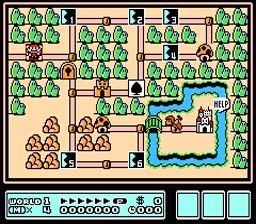
Similarly in Super Mario Brothers 3 there are two levels of gameplay, the map screen and the levels themselves. Although limiting, the map area does require interaction. The player can choose which levels to complete and tactically decide where to go depending on where the Hammer Brothers or the Coin Ship or whatever else is.
Levels of gameplay can serve to add depth to a game and to prevent the game seeming repetitive.

The Experimental Gameplay Workshop was also really cool. I think it's fantastic that new and exciting methods of play are being recognised for their merits, and I think that they are the games which will help move the industry forward. I so want to play Katamari Damacy, but the last I heard we only had the second game over here, which apparently has a slightly different feel to it. Experimental gameplay seems to be about the same kind of thinking they taught us in art college - think away from what you have, and then come back again. Figure out some crazy, non related thing and then relate it back to how you can structure your game.

I don't think gameplay can be entirely designed into a game as different factors affect it. If you had the gameplay as you wanted it but suddenly had to change an element of the control system because it was causing problems then the gameplay would inevitably be affected. I think the gameplay element would be similar to a final piece of an art project - you would have an idea of what you wanted it to be like but different factors you explored along the way would eventually shape it.

Wednesday, December 13, 2006

Blogger

Why do they have to do this damn Blogger Beta thing to me? It's enough trying to remember eleventy billion passwords across the internet without having to create a google account just so I can forget another one!

My boyfriend Tim is currently signing up for Blogger. I dread to think what he's going to do with his account. The world will probably be treated to blueprints, videos, photos and crime scene evidence of every new explosive device he creates. To my knowledge, he has so far single handedly built out of readily available household material:
  • A gas powered tennis ball launcher which can shoot over a house.


  • A bicycle pump powered water cannon backpack which managed to shoot a jam jar higher than the height of his house when the pressure became too much.


  • a K'nex crossbow which fires bits of K'nex at people.


  • A 3 wheeled go kart.


  • A secret underground lair which was basically a big hole underground with a shed constructed inside it once it was finished, complete with Batman style ramp to the surface world.


  • A wooden crossbow.


  • A sword. As in like proper metal, cut you up sword.

Not to mention various adventures with explosives. Needless to say, I will feel safe with him when the Zombie Apocalypse arrives.

Sunday, December 10, 2006


Week 10: Story and Character

A few of the articles for this week's task really made me annoyed. The design and purpose for the characters in Ninety Nine Nights seemed really thought out and meaningful and then they hit you with this: '
When I was Inphyy, I liked her, she's cute and has a nice body. She has good cleavage, I threw that in for the player's sake.' You have got to be kidding me! You went to all this trouble to design a deep, well rounded, interesting woman and then decided that you know what, she still needs big tits. Because who's going to buy it if it doesn't have big tits in it?! This idea of the player is also slightly strange. It should say the male player. Or the player who is attracted to breasts. To be honest a character with boobs spilling out of her armour does not appeal to me whatsoever. It says lazy design and lack of practicality.

Anyway. I will stop being hrr arrgh feminist now and return to the task in hand. What characters do I respond to? This is an incredibly broad question so I'm going to try to brea
k it down a bit.

Appearance
In live action filming, the way a character looks is predetermined by the actor. They can be changed through makeup and costume but each actor will bring certain preconceived ideas with them to a character.
By constrast
in animation and games the character's whole appearance needs to be designed and there is no base to work from. At the moment I think animation deals with this more enthusiastically than games do. Animation seeks to create exaggerated characters and worlds with unrealisitic proportions. Just look at Corpse Bride, The Incredibles or anime in general for strange proportions. Games seem to be stuck in a rut of trying to emulate reality when they have far more freedom than they give themselves credit for. Why have photorealistic humans or foliage? If we want that we can just go outside. Some games do well at breaking away from this. Timesplitters, Sam n Max and Windwaker managed to use chariacatures to great effect without making you feel as if it was outside of the game's reality.
So I respond to characters who look good, who have a certain spark about them. Captain Jack Sparrow with his planned out costume, Mike and Sully from Monsters Inc with their contrasting body shapes and sizes.

Script:

I'm going to talk about the podcast by Tim Schafer for a little bit now. I found it a really interesting talk, and the ideas of drawing inspiration from real life and that there can be different fantasies people want to fulfil seemed very important. Basically to summarise the second idea was in regards to playing as Guybrush Threepwood in Monkey Island. Tim said that someone had remarked to him that they enjoyed playing as Guybrush because they always had a witty comeback, something a lot of people struggle with in real life. There is more to games than just being a powerful warrior.
Writing for a character is about making them believable. I read somewhere that you shouldn't have a character who is 100% what you expect them to be. I think it was in Trigger Happy, I can't remember. Basically, if you have a good guy, make him 3/4 good characteristics and 1/4 bad. Like noble, witty, compassionate but ugly. I think this is well illustrated by Bender fro
m Futurama. Bender doesn't care about anybody but himself. He is selfish, lazy, lies and steals but when you get a rare moment of positive emotion from him it means so much more. Like when he actually becomes friends with Fry or when he falls in love.
Character writing I like includes stuff by Pratchett, Shaun of the Dead and Sly Raccoon 3.

Acting
Acting can change everything about a character. You learn this when you study different versions of Shakespeare plays put on by different companies. In one version of the Merchant of Venice, Shylock is the evil, vicious Jew who wants nothing but mindless vengeance. In another, he is the poor victim of circumstance who wants only what is due to him. These are the same lines in each case but acted differently. Actors can bring new life to a character. The character of Hades in the Disney film Hercules was changed entirely when James Woods auditioned for the part. Instead of being slow and lumbering, Hades became quick witted and cynical.
An actor who seems to turn up again and again in games I play is James Arnold Taylor. http://en.wikipedia.org/wiki/James_Arnold_Taylor . He played both Tidus and Ratchet and pops up in lots of other cartoons and voiceovers. I think he's a good actor and the cast interviews with him about Final Fantasy X were really interesting, he really knew what he was trying to convey with Tidus.


Sunday, December 03, 2006

Week 9: Game Technology

Personally, I don't think that consoles and controllers becoming more aesthetically pleasing is a terrible thing. It can of course be argued as being 'style over substance' but I think it's nice that video games are considering their image and are changing it to reflect their audience.

The PS3 controller is slightly disappointing. It has barely changed despite Sony's ten years of console experience. The only way it seems to be different to a PS2 controller is a single button in the middle. Sony seems to be a rather avid borrower of ideas from other consoles when it comes to design. The XBox 360 controller has at least been tidied up a bit. Smoothed out, rounded and slick looking, it's a nice improvement but nothing shocking. The middle button allows easy menu access, important to a console which prides itself on its online capabilities.
The Wii controller however, seems to be going in a completely new direction. The smooth whiteness is there like the XBox controller, but the remote is basically a rectangle. What are Nintendo doing? The thing is a slightly elongated, sideways NES controller!
But here is the beauty of the thing. When you played NES games, you never forgot what the controls were, because there were only 2 buttons and a D-pad. Nintendo has stripped its controller down to the basic essentials and made it easy to just pick up and use.

Controllers are often a barrier between the user and the game for inexperienced gamers. Watching my mum or my flatmates try to play on a console is amusing but also interesting because they don't understand what the controller can do, they don't intuitively know where the buttons are and how you use them. Instead of being absorbed in the experience, they are sitting there going 'Oh god how do I jump?!'

Let's find a control menu for something. Ah yes, Shadow of the Colossus. That will do:

Left Analog stick: Used for movement.
Right Analog Stick: Moves the camera about freely.
Directional Pad: Use the left and right arrows to change your weapons.
X-button: Summon your horse.
Square-button: Attack button. Use it to slash your sword or fire your arrows.When equipped with your sword, use the square button to charge up for a strongstab (used in combination with R1).
Triangle-button: The jump button. Also used to mount your horse when you are standing next to him. Used to jump out of water as well.
Circle-button: Used to reflect the sunlight off your sword. You can also use Circle to pray at the save alters.
R1-button: Used to grab climbable surfaces, walls, ledges, etc. Hold this and use triangle and left stick to jump/roll when you aren't climbing. You can also use this to dive underwater a short distance.
R2-button: Zooms in.
L1-button: Look about at your surroundings and focus on the colossus (when incombat).
L2-button: Re-positions the camera behind you.
START-button: Pause/Displays your map. The arrow is your current position andthe direction you are facing.--On Agro--Left Analog stick: Used to change his direction.
Triangle-button: Mount/Dismount.
Triangle + R1: Used to fast-mount the horse when you leap from the ground.
X-button: Kick the horse to make him go faster. You can hold it down to keep him at his maximum speed.
Down on L-stick + X: When standing still, you can rear-up and take off atmaximum speed really quick. When moving fast, this will put you back at zero-movement (skid stop and all). Also you can hit X twice from a gallop and downto do an instant 180.
R1 + Up on L-stick: Stand on the horse. From here you can jump off ontosomething else.
R1 + any button + left/right on L-stick: hang off the side of the saddle.
Circle-button: Raises sword when equipped, pets Agro when the hand icon is shown.

I'm not being funny I love this game but there are so many button combinations and different things a button can do depending on the circumstances. I'd nearly completed the game before I found out you could actually pet Agro. This is not pick up and play material and I think that this is the thing games should be trying to be right now.

So basically I think my point after all this is that consoles need to be appealing to more people. Sony and Microsoft have done that with their console designs but Nintendo have gone the extra mile with a controller that will mean eveyone in your family can play, not just the gamers.